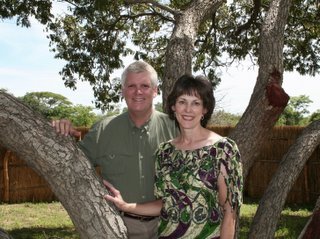

I have been thinking about writing a blog entry describing a typical day in Zambia. The difficulty is finding any day that is typical. Instead I’ll just describe last Tuesday.
I was up at 5:00 for quiet time and study. I teach a college women’s class on Tuesday nights, so I spent some time preparing for that. At around 7:00 I was in the kitchen to fix hot water for tea. I opened the kitchen curtains and waved at Bernard, one of the workers who is finishing the water tower in the back yard. We’ve learned to be up and dressed early here! Other men who are working on the fence and water tower began coming in.
At 8:00 I gathered some paperwork for sponsored students and started the rounds of the campus to try to locate the people I needed to talk to. The finance office was still locked, so I went across to the opposite end of the campus to the secondary school and had a meeting with the headmaster and one of the teachers. We finished our meeting in time for me to catch two of the secondary students who need sponsors as they were leaving chapel. I took their pictures and got their information for an upcoming issue of the Kalomo Reporter.
Chapel for the college students was at 9:00. When it ended at 9:30 David and I headed back to the house. We were expecting guests that night, so I spent some time getting the guest bedroom organized and in order. At 10:30 I gathered up more paperwork and met with the principal of the college about sponsored students.
The power went off around noon, so one of the workers built a fire in the backyard to cook nshima and cabbage for lunch. We joined the five workers and ate outside on the veranda.
The afternoon was filled with a steady stream of college students coming to the door and asking what to do about paying the balances due on their accounts. I gave whatever advice I could and promised to try to find help for them to pay for this term if they could work on paying off what they owed for the last two terms. In between students, David and I hung mosquito nets in the guest room and got rid of the last of the packing boxes.
At 4:00 one of the students in David’s Bible class came by. I had meetings scheduled with sponsored students, so David took him back to one of the bedrooms and had a Bible study with him while I met with individual students in the living room and others waited on our veranda. At 5:00 there was a break. The power was still off, so I looked through the refrigerator to find something we could eat that wouldn’t require cooking. We started gathering candles and flashlights. At 5:30 another group of students came by and we talked to them. At 6:00 Patson came by to pick up some papers and luggage for his trip to the US.
The power came on briefly, so we thought we would still be able to have our Bible studies that evening. After my 7:00 class at the college, David was planning to host a Bible study for faculty and staff at our house at 8:00. Around 6:45 the power started to fade again and by 7:00 we were in total darkness. There would be no Bible studies.
We took our flashlights and sat outside on the veranda and watched what little we could see of the darkened campus. A few minutes later the Andrew, the maintenance supervisor, rode up on his motorcycle. There was an electrical line down in Kalomo, he said, and no one in town had flashlights so that they could see to work on it. Could we help? We rounded up our biggest and brightest flashlights to give him and he headed back into town. One of the clinic workers arrived a few minutes later. The power was on at his house, so he thought we would be having our Bible study. He stayed to visit with us for a few minutes.
At 8:30 Brian and Sondra Davis arrived with their two little boys. Brian and Sondra are in the process of moving from Cape Town, South Africa, to northern Zambia to open a new mission work there. We showed them around our darkened house by candlelight and helped them bring in their luggage and start getting settled for the night.
At 9:00 there was a knock on the door. The student David studied with had come to be baptized and had brought seven of his friends with him. We grabbed flashlights and candles and headed out to the backyard. Our brick and concrete in-ground water cistern had just been filled with water. It was big enough for David and his student to climb down into for the baptism. We sang and prayed together after the baptism, and the guys went back to their dorm.
At 10:00 the maintenance supervisor called. The flashlights had worked great, he reported, and the power should be back on in five minutes. We had just climbed into bed when the house flooded with light. Best of all, the electric fans came on again to cool off the hot night. We gave thanks for another day. If we ever have a typical day, I’ll write about that one, too.
Wednesday, September 28, 2005


News and Notes - September 28
I'm sorry that I ever bragged on our nice weather here. It's over now. The days are hot, still, and dry. It does cool off at night, however. We enjoy sitting out on our veranda to catch whatever breezes we can.
Yesterday we had no power and no water from noon until 10:00 p.m. During that time we had at least twenty people in and out of the house, overnight guests who arrived in the dark, and a baptism in our backyard cistern. I'll write more details later.
I'm hearing from friends and family in Austin about your gas shortage. We've been out of diesel at the stations for over two weeks. We're getting our last reserves from the barrel now. When that's gone, life will get really complicated!
Yesterday we had no power and no water from noon until 10:00 p.m. During that time we had at least twenty people in and out of the house, overnight guests who arrived in the dark, and a baptism in our backyard cistern. I'll write more details later.
I'm hearing from friends and family in Austin about your gas shortage. We've been out of diesel at the stations for over two weeks. We're getting our last reserves from the barrel now. When that's gone, life will get really complicated!
Saturday at Kalundu
“Communication and transportation. Those are the hurdles to face.” A former missionary told me this several years ago. His words rang true all weekend.
Christopher Siatwiko and Jerrie Sichimwa work with several small congregations in the area. They came to us over a month ago and asked David and me to come to Kalundu to conduct an area-wide workshop for Bible school teachers. David was already booked to do medical mission follow-up for the next few weekends, but I offered to come out on Saturday, September 24, and do a two-hour session from 10:00 to 12:00 if I could arrange transportation. Jerrie assured me that Kalundu was not far from where we had done an earlier meeting at Sianongombe, an hour’s drive from Namwianga.
I talked with Bart Bruington who agreed that he would either take me there or let me use his Land Rover for that day. Christopher asked to borrow our bicycle so that he could “organize” the meeting by contacting all the congregations in the area and inviting them. Transportation and communication seemed to be handled.
I should have known better. I knew Christopher’s English was not great, but I thought Jerrie had gotten the message. Christopher and Jerrie showed up on Tuesday before the workshop and presented a letter from the Kalundu church leader. The letter was addressed to Brother Gregersen and Linda and stated that they were looking forward to both of us being with them for Saturday AND Sunday, September 24 and 25. Apparently as Christopher “organized,” he had expanded a two-hour teacher workshop into a two-day meeting with a teacher workshop as one part. I carefully tried to explain that David would NOT be going at all, and that I had only planned to teach on Saturday for two hours. Christopher smiled blankly. Jerrie and Christopher were committed for the two days and I was their transportation out there and back. Couldn’t I help?
I crumbled. I agreed to do the teacher workshop and one women’s class on Saturday. I would come back again on Sunday to teach the children IF I could arrange for a vehicle. I also offered to bring a singing group from the college for Sunday’s service.
In the meantime, Bart’s Land Rover had broken down and couldn’t be repaired until some parts were located. David was taking our Land Rover north to Sicikwalula for a three-day meeting there. I went to Mr. Limba at the Namwianga motor pool and asked if there was a school vehicle and driver available. He assured me that there was a “small van” available and that Donald could drive. The only problem was that the van had no shock absorbers. I asked him how many the van would hold, and he recommended “not more than 10 or 11 since it doesn’t have shocks.” I calculated the numbers I’d have for each trip and thought I was okay.
On Friday morning, things began to get complicated. David was sick in bed with a high fever from strep throat. Donald couldn’t drive, it seems, because he was officiating at a soccer tournament, and no other drivers were available. Mr. Limba said, “No problem, Linda. I’ve seen you drive the Land Rover. You can drive the van.” Hmm. I’d be okay going out there, because Christopher and Jerrie would know the way. But they were staying overnight, so coming back on Saturday afternoon I’d be by myself. I had visions of being lost in the bush, and I remembered the hours by the roadside when we were stranded at Munali Hill with a breakdown. David from his sickbed said absolutely not. I’d have to find someone to go out there and back with me on Saturday.
I was headed into Kalomo about that time when I met Donald on the road. We stopped to visit. He was sorry he couldn’t go, he said, and he offered to contact Mr. Limba about getting someone to accompany me. “How bad is it to drive the vehicle without shocks?” I asked him.
“Oh, it’s not too bad. It’s this one I’m driving here,” he said, and he patted the side of a SINGLE CAB pickup with a camper shell. It seems that Mr. Limba’s idea of a “van” and my idea of a “van” were very different! Most of the “10 or 11” people that Mr. Limba referred to would be riding in the back bed of the pickup.
Soon after I got back from town, Mr. Kunda, a college student, and Maria, a primary teacher, appeared at my door. They would be happy to accompany me on Saturday. Mr. Kunda assured me that he could change a flat tire if necessary, and that he would be able to help me find the way back. Maria just wanted to go along. We were set.
Since David was sick, he wasn’t going to Sicikwalula after all. Bart Bruington would be taking our Land Rover there on Sunday to speak in David’s place, but I could have the Rover for Saturday. At least one of the two trips to Kalundu would be with shock absorbers and real seats!
Jerrie had assured me the trip wouldn’t take more than two hours. Mr. Kunda, Maria, and I set out at 7:30 on Saturday morning. We stopped in Kalomo to pick up Christopher. His wife and aunt, he said, would be joining us “along the way.” We stopped for Jerrie at another village and then turned onto the Kabanga Road.
The Kabanga Road is miles and miles of bone-jarring, teeth-chattering, conversation-stopping washboard. It is the road by which all other roads around Namwianga are evaluated. “Is it as bad as the Kabanga Road?” is the question to ask about any unfamiliar roadway. My hands vibrated on the steering wheel as we jolted along for the first seventeen miles.
Then we turned off the “main” road onto another dirt road. This one was not too bad, but we did have to watch for huge potholes. A few miles later we turned onto an even smaller dirt road and slowed to a crawl. Eventually we crested a hill and headed down into a steep ravine. I held my breath as we approached the bottom and faced the 45-degree slope of the road leading out. “Mr, Kunda, do you know how to set the vehicle for four-wheel drive?” I gasped. He looked down at the knob tentatively and advised, “Just try it in first gear.” I shifted down, gripped the steering wheel, and gunned the accelerator. The Rover lurched up the side of the ravine. My white knuckles relaxed, and I began to breathe normally again.
We stopped to pick up Christopher’s wife, his aunt, and his baby (another surprise). The rest of the almost THREE-hour trip was more of the same: bad roads, potholes, and ravines. For the final mile we drove on a single-lane cow path. Mr. Kunda and I agreed: the school “van” would never have made it.
We climbed out of the Land Rover at Kalundu and were greeted by the church leaders who asked, “Where is Mr. Gregersen?” I looked at Christopher, and again he smiled blankly. The leaders held some whispered conferences to rearrange their plans. They decided to wait for a few more people to arrive before we began the teacher training. I would go ahead and teach the women’s class while Mr. Kunda taught the men. Maria was assigned to take the children and teach them.
We did those classes and then gathered back together for singing. The day wore on. At 1:15 I finally told Jerrie that I had to go ahead and do the teachers’ workshop so I could get home before dark. The men left for a leadership class with Mr. Kunda, and I did the teacher training. The women were excited and responsive about the ideas I shared. They willingly pretended to be children as we did some sample lessons together. When I finished and sat down, several of them took turns thanking me and begging me to come back again.
We ate the customary meal of nshima, chicken, and greens. I tried not to rush, but the minutes were ticking away. At last we said our goodbyes. I warned Jerrie and Christopher that I didn’t know whether or not I could come back on Sunday. It would all depend on whether I could find another vehicle for Bart to take to Sicikwalula. If I couldn’t, then Christopher and Jerrie would have to stay over on Sunday night and I would come back for them on Monday morning. I left extra food for them, and the rest of us set off for another bone-jarring ride back to Namwianga.
We made it home before dark with time to spare. I was relieved to find David feeling better. Bart tried to borrow a vehicle for his trip so I could use the Land Rover on Sunday, but there was none to be had. As I write this on Saturday night, Jerrie and Christopher are stuck at Kalundu until David and I can get back out there. I can’t tell them that, since Kalundu is far out of cell phone range. They’ll figure it out when I don’t show up on Sunday.
It’s all about transportation and communication.
Christopher Siatwiko and Jerrie Sichimwa work with several small congregations in the area. They came to us over a month ago and asked David and me to come to Kalundu to conduct an area-wide workshop for Bible school teachers. David was already booked to do medical mission follow-up for the next few weekends, but I offered to come out on Saturday, September 24, and do a two-hour session from 10:00 to 12:00 if I could arrange transportation. Jerrie assured me that Kalundu was not far from where we had done an earlier meeting at Sianongombe, an hour’s drive from Namwianga.
I talked with Bart Bruington who agreed that he would either take me there or let me use his Land Rover for that day. Christopher asked to borrow our bicycle so that he could “organize” the meeting by contacting all the congregations in the area and inviting them. Transportation and communication seemed to be handled.
I should have known better. I knew Christopher’s English was not great, but I thought Jerrie had gotten the message. Christopher and Jerrie showed up on Tuesday before the workshop and presented a letter from the Kalundu church leader. The letter was addressed to Brother Gregersen and Linda and stated that they were looking forward to both of us being with them for Saturday AND Sunday, September 24 and 25. Apparently as Christopher “organized,” he had expanded a two-hour teacher workshop into a two-day meeting with a teacher workshop as one part. I carefully tried to explain that David would NOT be going at all, and that I had only planned to teach on Saturday for two hours. Christopher smiled blankly. Jerrie and Christopher were committed for the two days and I was their transportation out there and back. Couldn’t I help?
I crumbled. I agreed to do the teacher workshop and one women’s class on Saturday. I would come back again on Sunday to teach the children IF I could arrange for a vehicle. I also offered to bring a singing group from the college for Sunday’s service.
In the meantime, Bart’s Land Rover had broken down and couldn’t be repaired until some parts were located. David was taking our Land Rover north to Sicikwalula for a three-day meeting there. I went to Mr. Limba at the Namwianga motor pool and asked if there was a school vehicle and driver available. He assured me that there was a “small van” available and that Donald could drive. The only problem was that the van had no shock absorbers. I asked him how many the van would hold, and he recommended “not more than 10 or 11 since it doesn’t have shocks.” I calculated the numbers I’d have for each trip and thought I was okay.
On Friday morning, things began to get complicated. David was sick in bed with a high fever from strep throat. Donald couldn’t drive, it seems, because he was officiating at a soccer tournament, and no other drivers were available. Mr. Limba said, “No problem, Linda. I’ve seen you drive the Land Rover. You can drive the van.” Hmm. I’d be okay going out there, because Christopher and Jerrie would know the way. But they were staying overnight, so coming back on Saturday afternoon I’d be by myself. I had visions of being lost in the bush, and I remembered the hours by the roadside when we were stranded at Munali Hill with a breakdown. David from his sickbed said absolutely not. I’d have to find someone to go out there and back with me on Saturday.
I was headed into Kalomo about that time when I met Donald on the road. We stopped to visit. He was sorry he couldn’t go, he said, and he offered to contact Mr. Limba about getting someone to accompany me. “How bad is it to drive the vehicle without shocks?” I asked him.
“Oh, it’s not too bad. It’s this one I’m driving here,” he said, and he patted the side of a SINGLE CAB pickup with a camper shell. It seems that Mr. Limba’s idea of a “van” and my idea of a “van” were very different! Most of the “10 or 11” people that Mr. Limba referred to would be riding in the back bed of the pickup.
Soon after I got back from town, Mr. Kunda, a college student, and Maria, a primary teacher, appeared at my door. They would be happy to accompany me on Saturday. Mr. Kunda assured me that he could change a flat tire if necessary, and that he would be able to help me find the way back. Maria just wanted to go along. We were set.
Since David was sick, he wasn’t going to Sicikwalula after all. Bart Bruington would be taking our Land Rover there on Sunday to speak in David’s place, but I could have the Rover for Saturday. At least one of the two trips to Kalundu would be with shock absorbers and real seats!
Jerrie had assured me the trip wouldn’t take more than two hours. Mr. Kunda, Maria, and I set out at 7:30 on Saturday morning. We stopped in Kalomo to pick up Christopher. His wife and aunt, he said, would be joining us “along the way.” We stopped for Jerrie at another village and then turned onto the Kabanga Road.
The Kabanga Road is miles and miles of bone-jarring, teeth-chattering, conversation-stopping washboard. It is the road by which all other roads around Namwianga are evaluated. “Is it as bad as the Kabanga Road?” is the question to ask about any unfamiliar roadway. My hands vibrated on the steering wheel as we jolted along for the first seventeen miles.
Then we turned off the “main” road onto another dirt road. This one was not too bad, but we did have to watch for huge potholes. A few miles later we turned onto an even smaller dirt road and slowed to a crawl. Eventually we crested a hill and headed down into a steep ravine. I held my breath as we approached the bottom and faced the 45-degree slope of the road leading out. “Mr, Kunda, do you know how to set the vehicle for four-wheel drive?” I gasped. He looked down at the knob tentatively and advised, “Just try it in first gear.” I shifted down, gripped the steering wheel, and gunned the accelerator. The Rover lurched up the side of the ravine. My white knuckles relaxed, and I began to breathe normally again.
We stopped to pick up Christopher’s wife, his aunt, and his baby (another surprise). The rest of the almost THREE-hour trip was more of the same: bad roads, potholes, and ravines. For the final mile we drove on a single-lane cow path. Mr. Kunda and I agreed: the school “van” would never have made it.
We climbed out of the Land Rover at Kalundu and were greeted by the church leaders who asked, “Where is Mr. Gregersen?” I looked at Christopher, and again he smiled blankly. The leaders held some whispered conferences to rearrange their plans. They decided to wait for a few more people to arrive before we began the teacher training. I would go ahead and teach the women’s class while Mr. Kunda taught the men. Maria was assigned to take the children and teach them.
We did those classes and then gathered back together for singing. The day wore on. At 1:15 I finally told Jerrie that I had to go ahead and do the teachers’ workshop so I could get home before dark. The men left for a leadership class with Mr. Kunda, and I did the teacher training. The women were excited and responsive about the ideas I shared. They willingly pretended to be children as we did some sample lessons together. When I finished and sat down, several of them took turns thanking me and begging me to come back again.
We ate the customary meal of nshima, chicken, and greens. I tried not to rush, but the minutes were ticking away. At last we said our goodbyes. I warned Jerrie and Christopher that I didn’t know whether or not I could come back on Sunday. It would all depend on whether I could find another vehicle for Bart to take to Sicikwalula. If I couldn’t, then Christopher and Jerrie would have to stay over on Sunday night and I would come back for them on Monday morning. I left extra food for them, and the rest of us set off for another bone-jarring ride back to Namwianga.
We made it home before dark with time to spare. I was relieved to find David feeling better. Bart tried to borrow a vehicle for his trip so I could use the Land Rover on Sunday, but there was none to be had. As I write this on Saturday night, Jerrie and Christopher are stuck at Kalundu until David and I can get back out there. I can’t tell them that, since Kalundu is far out of cell phone range. They’ll figure it out when I don’t show up on Sunday.
It’s all about transportation and communication.
Friday, September 23, 2005
News and Notes - September 23
We have been plagued with inter-net problems. The e-mail account that we use has suddenly decided to do all kinds of crazy things. Our usual procedure had been to go online for just a few minutes every few days and then read and write our e-mails offline. Now we haven’t been able to read anything offline, even the things we opened when we were online. To complicate things even more, the electricity was off at the Merritts where we go to do our e-mails, so we couldn’t even get online for a while. We are trying hard to get our own inter-net service set up, but it is a complicated process that may require another two weeks or so.
We are now teaching at the college. In addition to our regular classes, I am teaching a college women’s Bible study every Tuesday night. David is also teaching a faculty/staff evening Bible study on the book of Nehemiah.
The diesel shortage is keeping life interesting. There is some diesel available in the area, but knowing where and when to find it is a challenge. Our basic method is to fill up at any station that has diesel so we can keep the tank full.
Last week our house was without water for almost three days. Some villagers along the water line had broken the pipe to get water for themselves. Then they let the water pool up around the broken pipe so they could water their animals. We are now prepared in case we have to go without water again. We have a 55-gallon barrel in the corner of our bathroom that we have filled with water for emergencies. Eventually we will have a water tower and tank, but the construction is proceeding slowly.
Last Sunday we attended the grand opening of the newest orphanage in the area. This one is called Seven Fountains and is run by Rod and Sue Calder. Sue loves taking in the youngest babies, so her nursery rooms are full of tiny ones. In addition to orphan care, the Calders also run a large farm, including a dairy herd. We often buy our milk there.
This weekend David and I will be going on outreaches in different directions. David is heading up north to Sicikwalula for a weekend meeting. I am doing a teacher training workshop for an area-wide gathering about an hour east of Namwianga. David gets the Land Rover since he’s going much farther. My transport will be a small van from the school’s motor pool. I’ve already been warned that it has no shock absorbers, so it should be quite a trip. Who needs a Six Flags ride when you can have a real adventure on African bush roads?
We are now teaching at the college. In addition to our regular classes, I am teaching a college women’s Bible study every Tuesday night. David is also teaching a faculty/staff evening Bible study on the book of Nehemiah.
The diesel shortage is keeping life interesting. There is some diesel available in the area, but knowing where and when to find it is a challenge. Our basic method is to fill up at any station that has diesel so we can keep the tank full.
Last week our house was without water for almost three days. Some villagers along the water line had broken the pipe to get water for themselves. Then they let the water pool up around the broken pipe so they could water their animals. We are now prepared in case we have to go without water again. We have a 55-gallon barrel in the corner of our bathroom that we have filled with water for emergencies. Eventually we will have a water tower and tank, but the construction is proceeding slowly.
Last Sunday we attended the grand opening of the newest orphanage in the area. This one is called Seven Fountains and is run by Rod and Sue Calder. Sue loves taking in the youngest babies, so her nursery rooms are full of tiny ones. In addition to orphan care, the Calders also run a large farm, including a dairy herd. We often buy our milk there.
This weekend David and I will be going on outreaches in different directions. David is heading up north to Sicikwalula for a weekend meeting. I am doing a teacher training workshop for an area-wide gathering about an hour east of Namwianga. David gets the Land Rover since he’s going much farther. My transport will be a small van from the school’s motor pool. I’ve already been warned that it has no shock absorbers, so it should be quite a trip. Who needs a Six Flags ride when you can have a real adventure on African bush roads?
Thursday, September 15, 2005
Outreaches
In our August newsletter I described a typical outreach Sunday. For those of you who aren’t on that list, I am repeating the article here. I am also adding news of our most recent outreaches.
Namwianga Mission sends workers out each weekend for outreaches to village congregations in the area. These trips usually involve an early morning start as we drive the Land Rover around the mission and collect Zambian co-workers to go with us. Then we set out on a (usually) long drive over rough roads. When we arrive at the village we are greeted warmly and invited to sit on rough-hewn plank benches inside a mud-brick and thatch church building.
Usually one of the Zambians who came with us gives the communion message and then David preaches. I often take the children outside for a Bible lesson during the preaching. Sometimes the church requests a class after the worship assembly, so David teaches the men and I teach the ladies. A few of the ladies cook all morning over an open fire, and they then serve us a dinner of nshima, chicken or goat meat, and greens.
By three in the afternoon we say our goodbyes and load up again to leave. It’s not uncommon for us to take on a new passenger or two (or TEN) for the return trip, and we often have luggage, bags of groundnuts (peanuts), or a bicycle strapped onto the top rack of the Land Rover.
When we arrive back at the mission our bodies are tired and dusty, but our spirits are refreshed from the fellowship we enjoyed.
On August 27 our outreach was at an area-wide gathering in Dengezu. The five-hour journey was on some of the worst roads we have encountered in Zambia. We were very thankful for four-wheel drive on the Rover. David preached the morning sermon and I did the children’s program. The congregation had built a huge brush arbor to accommodate the 700 plus adults who attended. I had about 180 children in my class. The numbers are astounding when you consider that there were only two motorized vehicles there, both from Namwianga. Everyone else had come on foot, bicycle, or in an ox cart. When we got ready to leave, a group from Zimbabwe asked to ride with us to the main road. We filled the inside of the Land Rover, piled luggage on top, and then four of the young men climbed up on top and held on tight as we bounced and jolted for the next hour. When we dropped them off they still had a long walk to the point where they would catch a bus across the border.
On September 4 we visited another area-wide meeting, this time at Sianombe near Kalomo. David spoke and I did the children’s program. We had 125 adults and 40 children at this gathering.
Last weekend we went to Siomopele for yet another area-wide meeting. This one started on Saturday, so we were there bright and early Saturday morning. David spoke while I taught the children for three hours. That afternoon we taught a class on marriage. We returned to Namwianga for the night and went out again on Sunday morning. David delivered the morning sermon while I had the children. There were nine baptisms.
There are always some surprises at these gatherings. At Dengezu we learned to take our own plates to an area-wide meeting. When there are so many people to feed, dishes are scarce. We ate out of communal bowls there. At Siomopele the church leader came to the children’s program to tell us that the adults were walking to the river for the baptisms and the children would be staying with me. I had already been teaching for three hours that morning, and the baptisms added another hour. Thankfully, the children love to sing, so my translator and I filled most of the time leading songs in both Tonga and English.
When you worship on Sunday morning in America, remember your brothers and sisters in Africa who are also praising and serving the Lord.
Namwianga Mission sends workers out each weekend for outreaches to village congregations in the area. These trips usually involve an early morning start as we drive the Land Rover around the mission and collect Zambian co-workers to go with us. Then we set out on a (usually) long drive over rough roads. When we arrive at the village we are greeted warmly and invited to sit on rough-hewn plank benches inside a mud-brick and thatch church building.
Usually one of the Zambians who came with us gives the communion message and then David preaches. I often take the children outside for a Bible lesson during the preaching. Sometimes the church requests a class after the worship assembly, so David teaches the men and I teach the ladies. A few of the ladies cook all morning over an open fire, and they then serve us a dinner of nshima, chicken or goat meat, and greens.
By three in the afternoon we say our goodbyes and load up again to leave. It’s not uncommon for us to take on a new passenger or two (or TEN) for the return trip, and we often have luggage, bags of groundnuts (peanuts), or a bicycle strapped onto the top rack of the Land Rover.
When we arrive back at the mission our bodies are tired and dusty, but our spirits are refreshed from the fellowship we enjoyed.
On August 27 our outreach was at an area-wide gathering in Dengezu. The five-hour journey was on some of the worst roads we have encountered in Zambia. We were very thankful for four-wheel drive on the Rover. David preached the morning sermon and I did the children’s program. The congregation had built a huge brush arbor to accommodate the 700 plus adults who attended. I had about 180 children in my class. The numbers are astounding when you consider that there were only two motorized vehicles there, both from Namwianga. Everyone else had come on foot, bicycle, or in an ox cart. When we got ready to leave, a group from Zimbabwe asked to ride with us to the main road. We filled the inside of the Land Rover, piled luggage on top, and then four of the young men climbed up on top and held on tight as we bounced and jolted for the next hour. When we dropped them off they still had a long walk to the point where they would catch a bus across the border.
On September 4 we visited another area-wide meeting, this time at Sianombe near Kalomo. David spoke and I did the children’s program. We had 125 adults and 40 children at this gathering.
Last weekend we went to Siomopele for yet another area-wide meeting. This one started on Saturday, so we were there bright and early Saturday morning. David spoke while I taught the children for three hours. That afternoon we taught a class on marriage. We returned to Namwianga for the night and went out again on Sunday morning. David delivered the morning sermon while I had the children. There were nine baptisms.
There are always some surprises at these gatherings. At Dengezu we learned to take our own plates to an area-wide meeting. When there are so many people to feed, dishes are scarce. We ate out of communal bowls there. At Siomopele the church leader came to the children’s program to tell us that the adults were walking to the river for the baptisms and the children would be staying with me. I had already been teaching for three hours that morning, and the baptisms added another hour. Thankfully, the children love to sing, so my translator and I filled most of the time leading songs in both Tonga and English.
When you worship on Sunday morning in America, remember your brothers and sisters in Africa who are also praising and serving the Lord.
Finally
At long last we have moved into our new house! It has been so much fun opening boxes that were packed last January. We still have much to do before we’ll be completely settled, but we are thrilled to be here. As soon as we can get out own internet connection we’ll be sending pictures.
From David - Church Planting
I have already had the privilege of helping start a new congregation. The first weekend in September my Zambian co-worker, Rogers Namuswa, and I went out to follow up on some people who were baptized at Singwamba during the medical mission. We left on Friday at noon and drove north into the bush. It was so far back I thought that if the Land Rover broke down I would be wearing a loincloth, eating roots, and talking fluent Chitonga before we made it back. We found a village headman and his wife that we baptized back in July. He was staying at his uncle's village and preparing to move his family farther north into Kafue Game Park to start another village. We met with his family and his uncle's family (thirty people) around the campfire that night. We told them how to start a church. I told the story of Jesus feeding the 5,000. I encouraged them to offer up their knowledge, efforts, and talents to Jesus and watch Him multiply them. We asked Obed, a Christian from a nearby village, to come that Sunday and help them hold their first service out in the bush under the trees. (Both Rogers and I had previous commitments and couldn’t be there.)
That Friday night I tied one end of my hammock to a tree and the other end to the back of the Land Rover and went to sleep with the sounds of hyenas laughing out in the bush. On Saturday morning we did some more teaching and headed back to Namwianga. We distributed Chitonga bibles to four different village congregations as we went along.
This week we learned what happened. The first Sunday the new congregation started with 31 present. There were also some requests for baptism. The next week Rogers and another missionary went for the Sunday gathering. (Again, I had already been asked to speak at an area-wide meeting, so I couldn’t go). There were 54 people for this second Sunday. Thirteen responded to the preaching, and seven were baptized. Rogers had strapped a 6-foot galvanized water trough to the top of the Land Rover to use for the baptisms. Water is scarce this time of the year, so at the water source the Zambians used buckets to fill the trough with enough water for the baptisms.
This new congregation is inside Kafue Game Park, one of the largest game refuges in southern Africa. The kingdom continues to grow in Zambia as God continues to multiply what we offer in time, talents, and effort.
David
That Friday night I tied one end of my hammock to a tree and the other end to the back of the Land Rover and went to sleep with the sounds of hyenas laughing out in the bush. On Saturday morning we did some more teaching and headed back to Namwianga. We distributed Chitonga bibles to four different village congregations as we went along.
This week we learned what happened. The first Sunday the new congregation started with 31 present. There were also some requests for baptism. The next week Rogers and another missionary went for the Sunday gathering. (Again, I had already been asked to speak at an area-wide meeting, so I couldn’t go). There were 54 people for this second Sunday. Thirteen responded to the preaching, and seven were baptized. Rogers had strapped a 6-foot galvanized water trough to the top of the Land Rover to use for the baptisms. Water is scarce this time of the year, so at the water source the Zambians used buckets to fill the trough with enough water for the baptisms.
This new congregation is inside Kafue Game Park, one of the largest game refuges in southern Africa. The kingdom continues to grow in Zambia as God continues to multiply what we offer in time, talents, and effort.
David
Monday, September 12, 2005
No Diesel Again
We have been able to buy diesel for the past three weeks. Now the news is out that Zambia’s ONE diesel refinery is closing down again for two weeks. We’ve filled all the tanks, jerry cans, and barrels we can find, and we’ll be staying close to home for a while.
Moving? Not Yet!
Well, it’s Sunday and we haven’t spent the night in our new house yet! Life has been one interruption after another for the past week. We spent Monday and Tuesday getting the floors done. Wednesday we moved in all our bigger pieces of furniture (and there aren’t very many). We also spent several hours dealing with people who came by wanting money, piecework, or food. Then on Wednesday afternoon we got word that the president of the Zambian Board was coming into town and wanted to stay with us at the Hamby house Wednesday and Thursday nights. So we put the move on hold. We did go ahead and move in almost all our things on Thursday and I got curtains hung in some of the windows in between dealing with people coming by with messages and requests for help. The man who was to finish the kitchen cabinets had still not come, so we couldn’t unpack the kitchen items. We said we’d try to move on Friday afternoon!
On Friday we had our first staff meeting at the college. It lasted from 9:00 to 1:00. As I returned to the house I received word from the Secondary School that I was to meet with the U. S. sponsored students at 2:00. I’ll write more on this later, but I was interviewing the students who receive money for school from individuals and churches in the U. S. I started at 2:00 and finished a little before 6:00. David came to meet me with the news that one of our Zambian friends was bringing his family to spend the weekend. We weren’t ready for company in the new house, so the move was put on hold again. Our friends arrived at 11:00 Friday night with two of their children and a nephew in tow. Their vehicle was having problems that just got fixed today, so they will be here until Monday.
On Saturday and on Sunday morning we were speaking and teaching at an area-wide meeting out in the bush, so we couldn’t do anything on the house. Sunday afternoon we got home around 2:00 and went down to the new house to do a little more work. We are promising ourselves that we will sleep in the new house Monday night no matter what it takes!
On Friday we had our first staff meeting at the college. It lasted from 9:00 to 1:00. As I returned to the house I received word from the Secondary School that I was to meet with the U. S. sponsored students at 2:00. I’ll write more on this later, but I was interviewing the students who receive money for school from individuals and churches in the U. S. I started at 2:00 and finished a little before 6:00. David came to meet me with the news that one of our Zambian friends was bringing his family to spend the weekend. We weren’t ready for company in the new house, so the move was put on hold again. Our friends arrived at 11:00 Friday night with two of their children and a nephew in tow. Their vehicle was having problems that just got fixed today, so they will be here until Monday.
On Saturday and on Sunday morning we were speaking and teaching at an area-wide meeting out in the bush, so we couldn’t do anything on the house. Sunday afternoon we got home around 2:00 and went down to the new house to do a little more work. We are promising ourselves that we will sleep in the new house Monday night no matter what it takes!
Tuesday, September 06, 2005
Moving?
We THINK we will move into our house on Wednesday. We've spent the past two days working on the floors. You wouldn't think that waxed concrete should be that difficult, but this is Zambia. Some workers were hired to go in and wax the floors last week. They did. In fact, they waxed right over all the paint drops and spills that were still on the concrete. So we have had anywhere from two to six guys working for two days to remove the wax and remove the paint spills (sandpaper and paint thinner and lots of exertion) and then rewax the floors. I have vague unpleasant memories of waxing floors in my childhood, so this has been quite an education. The wax is put on the floors using a rag or just bare hands. When the wax is dry, the floor has to be polished with a brush and then wiped again with a polishing cloth.
Now that the floors are done, there are just a few more details to be finished. We'll keep you posted.
Now that the floors are done, there are just a few more details to be finished. We'll keep you posted.
Thursday, September 01, 2005
God At Work
We arrived in Zambia on June 23 and quickly discovered that God had placed us in the right place at the right time to help World Bible School students.
Ruth Orr, a WBS correspondence teacher from Lewisburg, Tennessee contacted the WBS office in Austin seeking help. She had several students in the prison at Kabwe, Zambia who had requested baptism. Ruth had been unable to find a contact person who could follow up with her students.
Kevin Rhodes of WBS knew we were in Zambia, so he e-mailed us with Ruth’s request for help. We looked up Kabwe on a map of Zambia and found that it was about a seven-hour trip away. We wrote back to Ruth and Kevin, telling them that we would ask our Zambian co-workers for help in getting to the prison. At the time, however, there was no diesel for sale in Zambia, so we didn’t think we’d be able to go there any time soon.
The day after we sent the e-mail to Ruth Orr, I met Louis Seemani, a member of Namwianga Mission’s Zambian board of directors who was here for the board meeting. I asked him where he was from and I was thrilled to hear him say, ‘Kabwe!’ I told him about the need for someone to visit the prison, and he willingly agreed to follow up on the WBS students.
We e-mailed Ruth Orr with the good news, but warned her that things move slowly in Zambia, so it might be some time before Mr. Seemani would be able to contact her students. The following Monday I received a call from Mr. Seemani. He had gone to the Kabwe prison on Sunday and visited four of the units, including Death Row and the maximum security areas. He had found over 100 prisoners who were already baptized believers, and he had made arrangements to go back the following week with a list of Ruth’s students. We are amazed at how God worked through us to help Mrs. Orr and these prisoners! We believe this is another affirmation he has placed us here for His work.
Ruth Orr, a WBS correspondence teacher from Lewisburg, Tennessee contacted the WBS office in Austin seeking help. She had several students in the prison at Kabwe, Zambia who had requested baptism. Ruth had been unable to find a contact person who could follow up with her students.
Kevin Rhodes of WBS knew we were in Zambia, so he e-mailed us with Ruth’s request for help. We looked up Kabwe on a map of Zambia and found that it was about a seven-hour trip away. We wrote back to Ruth and Kevin, telling them that we would ask our Zambian co-workers for help in getting to the prison. At the time, however, there was no diesel for sale in Zambia, so we didn’t think we’d be able to go there any time soon.
The day after we sent the e-mail to Ruth Orr, I met Louis Seemani, a member of Namwianga Mission’s Zambian board of directors who was here for the board meeting. I asked him where he was from and I was thrilled to hear him say, ‘Kabwe!’ I told him about the need for someone to visit the prison, and he willingly agreed to follow up on the WBS students.
We e-mailed Ruth Orr with the good news, but warned her that things move slowly in Zambia, so it might be some time before Mr. Seemani would be able to contact her students. The following Monday I received a call from Mr. Seemani. He had gone to the Kabwe prison on Sunday and visited four of the units, including Death Row and the maximum security areas. He had found over 100 prisoners who were already baptized believers, and he had made arrangements to go back the following week with a list of Ruth’s students. We are amazed at how God worked through us to help Mrs. Orr and these prisoners! We believe this is another affirmation he has placed us here for His work.
Monday, August 29, 2005
Stranded on Munali Hill
We knew it would happen sooner or later. It was only a matter of time. Our time to be stranded by a vehicle breakdown happened Wednesday. We had taken Patson, one of the Zambian evangelists, into Lusaka to apply for a visa at the American Embassy. We had spent the Tuesday night in Lusaka so that we could be at the embassy before 8:00 a.m. The application and interview took two hours, and then there was grocery shopping to be done. We were ahead of schedule when we left Lusaka at 2:00 in the afternoon, confident that we had plenty of time to complete the five-hour trip before dark.
At 3:30 the battery light came on and the engine started overheating. We were on a narrow two-lane road in the hills of Kafue by then and began looking desperately for a place to pull off where we would also have cell phone service. We finally located a “lay-by” or additional lane added for passing and stopping. As soon as the Land Rover stopped, the unmistakable sound of steam hissing from the radiator hit our ears. Boiling water spewed onto the pavement and ran down the hill. Diagnosis: broken fan belt.
We called Kelly Hamby back at Namwianga. Just an hour earlier, two big yellow school buses from the Mission had passed us on their way into Lusaka, taking women to a three-day meeting. Kelly called the drivers and asked them to bring one of the buses and tow us back to Namwianga. That seemed like a good enough plan, so we settled down to wait for our rescue.
Patson pointed out that we were on Munali Hill and there was a monument just across the road. We walked over and climbed up some steps to the top of a small hill. The marker noted that from this spot David Livingstone had first sighted the Kafue River. The local natives named the spot Munali Hill in honor of Livingstone. Munali means “The Red One.”
Sightseeing completed, we looked for other ways to fill the afternoon. I finished reading the biography of Albert Schweitzer and worked crossword puzzles until the sky began to darken. When the light faded, David, Patson, and I decided to get out of the vehicle and sit on the hillside. We enjoyed long conversations about our families and work at the mission. Patson taught us some Tonga hymns, and the night kept getting darker.
David had bought a newspaper in Lusaka and had read us an article about the night sky. It seems that Mars was going to be more visible this night than it had been in years. We were to look for it on the lower right of the moon. The only catch was that the sighting wouldn’t occur until 10:45. In the meantime there was no moon at all.
A moonless night in Zambia can be described by words like inky, black, and even . . . spooky. We have heard lots of stories about bush animals like lions and leopards. Our rational minds knew that those animals are found only in game parks, but I’ll admit that more than once we jumped up and shone the flashlight into the brush behind us when we heard a noise. We began to scan the road for vehicles coming our way, hoping each time that the lights were those of the big yellow bus coming to get us.
Four hours after we broke down, the bus finally pulled up. Jeremiah, Donald, and Zimba jumped out with the tow bar and (gulp) nothing to use to fasten the tow bar to the vehicles. They’d been searching the stores in Kafue for rope or chain and had no luck. No problem, we say, because we have these great tie-down straps for the Land Rover! The guys set to work fastening the tow bar to the Land Rover, but what’s this? The bus had no towing hitch! There are two yellow buses, you see, and only one has a hitch. I didn’t even want to ask why they chose to bring this one. There was some sort of hook under the bus, so they fastened the tow bar to the hook. This entire process took about an hour, but finally we slowly pulled out and headed up and over Munali Hill.
Donald and Zimba were in the Land Rover. Jeremiah was driving the bus with David, Patson, and I in it. We’d gone less than a mile when Donald started honking the horn. We stopped immediately, and this time there was no shoulder on the road, so were in the roadway. The hook on the bus faced the wrong direction, so the tow bar had already slipped off. The guys got busy trying to work on the situation, and I got busy with the flashlight directing traffic around our vehicles. Let’s just summarize the next hour by saying that I know a lot more about the size of 18-wheeler rigs than I really ever wanted to know. I utilized my favorite coping technique by singing all the verses of “Anywhere with Jesus” a few times.
(Side note to any of my former students who are reading this: I always taught that song to my classes so you would have it in your head when you were out in some dark, scary place and needed to remember some comforting words. It certainly worked for me!)
Once we were moving again, we decided to try a Plan B. We would stop at a village and leave the Land Rover to be picked up in the morning. We stopped at a roadside village. Again the road had no shoulder, so again we were right in the roadway and I was out directing traffic. By this time it was so late at night that there were very few vehicles moving. The dogs in the village announced our arrival, but no one came to greet us. The guys yelled a few times, but decided the villagers were too scared to come out, so we moved on.
Kelly called us at this point and gave us Plan C. John and Shadrach were on their way from Namwianga with a truck. We would find a safe place to leave the Land Rover with Donald in it, and John and Shadrach would come tow it in while the rest of us came on in the bus. By this time the guys had done a good job of getting the tow bar attached to the bus, so on we went. An hour later we limped into Mazabuka and found a deserted filling station. We unhitched the Land Rover and pushed it into a lighted area. Now we had to unload all the groceries from the Land Rover onto the bus. As we were doing this task, we discovered the station wasn’t deserted. It seems there was a night watchman, and he didn’t want us to leave the vehicle there, at least not without some rental fee. Some negotiations ensued, some kwacha went from David’s pocket into the watchman’s pocket, and Donald, Zimba, and the Land Rover stayed while the bus pulled out.
By the way, the moon did eventually come up and we had a spectacular view of Mars.
It was 2:00 a.m. when we arrived back at the mission. Again the groceries were unloaded. We collapsed into bed at 2:30 and slept as only those who have been stranded for hours by the side of a road in rural Zambia can sleep.
John and Shadrach, meanwhile, had taken a fan belt off another Land Rover at the mission before they set out. When they got to Mazabuka, they put that belt on our Land Rover and one of the guys drove the Land Rover home. All of them got in at 6:00 a.m.
The next day David and I marveled at how calmly we had handled the whole situation. Neither one of us had gotten upset or overly worried. We hadn’t snapped at each other or someone else in anger. We decided that this kind of situation is an expected happening when you live where we do and go where we go.
Just another day in Zambia.
At 3:30 the battery light came on and the engine started overheating. We were on a narrow two-lane road in the hills of Kafue by then and began looking desperately for a place to pull off where we would also have cell phone service. We finally located a “lay-by” or additional lane added for passing and stopping. As soon as the Land Rover stopped, the unmistakable sound of steam hissing from the radiator hit our ears. Boiling water spewed onto the pavement and ran down the hill. Diagnosis: broken fan belt.
We called Kelly Hamby back at Namwianga. Just an hour earlier, two big yellow school buses from the Mission had passed us on their way into Lusaka, taking women to a three-day meeting. Kelly called the drivers and asked them to bring one of the buses and tow us back to Namwianga. That seemed like a good enough plan, so we settled down to wait for our rescue.
Patson pointed out that we were on Munali Hill and there was a monument just across the road. We walked over and climbed up some steps to the top of a small hill. The marker noted that from this spot David Livingstone had first sighted the Kafue River. The local natives named the spot Munali Hill in honor of Livingstone. Munali means “The Red One.”
Sightseeing completed, we looked for other ways to fill the afternoon. I finished reading the biography of Albert Schweitzer and worked crossword puzzles until the sky began to darken. When the light faded, David, Patson, and I decided to get out of the vehicle and sit on the hillside. We enjoyed long conversations about our families and work at the mission. Patson taught us some Tonga hymns, and the night kept getting darker.
David had bought a newspaper in Lusaka and had read us an article about the night sky. It seems that Mars was going to be more visible this night than it had been in years. We were to look for it on the lower right of the moon. The only catch was that the sighting wouldn’t occur until 10:45. In the meantime there was no moon at all.
A moonless night in Zambia can be described by words like inky, black, and even . . . spooky. We have heard lots of stories about bush animals like lions and leopards. Our rational minds knew that those animals are found only in game parks, but I’ll admit that more than once we jumped up and shone the flashlight into the brush behind us when we heard a noise. We began to scan the road for vehicles coming our way, hoping each time that the lights were those of the big yellow bus coming to get us.
Four hours after we broke down, the bus finally pulled up. Jeremiah, Donald, and Zimba jumped out with the tow bar and (gulp) nothing to use to fasten the tow bar to the vehicles. They’d been searching the stores in Kafue for rope or chain and had no luck. No problem, we say, because we have these great tie-down straps for the Land Rover! The guys set to work fastening the tow bar to the Land Rover, but what’s this? The bus had no towing hitch! There are two yellow buses, you see, and only one has a hitch. I didn’t even want to ask why they chose to bring this one. There was some sort of hook under the bus, so they fastened the tow bar to the hook. This entire process took about an hour, but finally we slowly pulled out and headed up and over Munali Hill.
Donald and Zimba were in the Land Rover. Jeremiah was driving the bus with David, Patson, and I in it. We’d gone less than a mile when Donald started honking the horn. We stopped immediately, and this time there was no shoulder on the road, so were in the roadway. The hook on the bus faced the wrong direction, so the tow bar had already slipped off. The guys got busy trying to work on the situation, and I got busy with the flashlight directing traffic around our vehicles. Let’s just summarize the next hour by saying that I know a lot more about the size of 18-wheeler rigs than I really ever wanted to know. I utilized my favorite coping technique by singing all the verses of “Anywhere with Jesus” a few times.
(Side note to any of my former students who are reading this: I always taught that song to my classes so you would have it in your head when you were out in some dark, scary place and needed to remember some comforting words. It certainly worked for me!)
Once we were moving again, we decided to try a Plan B. We would stop at a village and leave the Land Rover to be picked up in the morning. We stopped at a roadside village. Again the road had no shoulder, so again we were right in the roadway and I was out directing traffic. By this time it was so late at night that there were very few vehicles moving. The dogs in the village announced our arrival, but no one came to greet us. The guys yelled a few times, but decided the villagers were too scared to come out, so we moved on.
Kelly called us at this point and gave us Plan C. John and Shadrach were on their way from Namwianga with a truck. We would find a safe place to leave the Land Rover with Donald in it, and John and Shadrach would come tow it in while the rest of us came on in the bus. By this time the guys had done a good job of getting the tow bar attached to the bus, so on we went. An hour later we limped into Mazabuka and found a deserted filling station. We unhitched the Land Rover and pushed it into a lighted area. Now we had to unload all the groceries from the Land Rover onto the bus. As we were doing this task, we discovered the station wasn’t deserted. It seems there was a night watchman, and he didn’t want us to leave the vehicle there, at least not without some rental fee. Some negotiations ensued, some kwacha went from David’s pocket into the watchman’s pocket, and Donald, Zimba, and the Land Rover stayed while the bus pulled out.
By the way, the moon did eventually come up and we had a spectacular view of Mars.
It was 2:00 a.m. when we arrived back at the mission. Again the groceries were unloaded. We collapsed into bed at 2:30 and slept as only those who have been stranded for hours by the side of a road in rural Zambia can sleep.
John and Shadrach, meanwhile, had taken a fan belt off another Land Rover at the mission before they set out. When they got to Mazabuka, they put that belt on our Land Rover and one of the guys drove the Land Rover home. All of them got in at 6:00 a.m.
The next day David and I marveled at how calmly we had handled the whole situation. Neither one of us had gotten upset or overly worried. We hadn’t snapped at each other or someone else in anger. We decided that this kind of situation is an expected happening when you live where we do and go where we go.
Just another day in Zambia.
Friday, August 26, 2005
News and Notes - August 26
If you remember, we were told our house would be ready August 20. Today is August 26, and the house is still not ready. It is getting closer, however! The painting is almost done. The kitchen cabinets are almost finished. The electrical wiring and plumbing are near completion.
In the meantime, we moved again. (Move number six in six months!) This time we moved into the Hamby’s house after they went back to the states. The guesthouse where we had been staying is reserved for a group from Canada beginning in early September. Plus, the kitchen at the Hamby house was all set up and ready, whereas the guesthouse kitchen did not have dishes, pans, and supplies out and ready to use. It was easier to move than to dig our kitchen stuff out of storage. Keep in mind that none of our moves here in Africa has involved much furniture—just clothes, books, and office supplies.
There has been diesel for sale for the last ten days or so. We’ve filled up at every opportunity and have kept our jerry cans filled as well. Now we’ve heard that the refinery--remember there is only one in Zambia--has had another problem and is shut down again. We are hoping for the best and are continuing to schedule outreaches.
A new missionary couple and their three children have joined the work at Namwianga. We are enjoying their company and are learning together. Keep Bart and Stacy Bruington and their children in your prayers as they adjust to this new way of life.
We have had so many adventures lately that I can’t get all of them onto the blog until I have more time to write. Be watching for “Stranded on Munali Hill” and for news about the well drilling project.
A scripture has sustained me over and over since we came to Africa. I memorized it in the King James Version years ago and still prefer that wording. From Isaiah 26:3 “Thou wilt keep him in perfect peace whose mind is stayed on Thee.”
Grace and Peace.
Linda
In the meantime, we moved again. (Move number six in six months!) This time we moved into the Hamby’s house after they went back to the states. The guesthouse where we had been staying is reserved for a group from Canada beginning in early September. Plus, the kitchen at the Hamby house was all set up and ready, whereas the guesthouse kitchen did not have dishes, pans, and supplies out and ready to use. It was easier to move than to dig our kitchen stuff out of storage. Keep in mind that none of our moves here in Africa has involved much furniture—just clothes, books, and office supplies.
There has been diesel for sale for the last ten days or so. We’ve filled up at every opportunity and have kept our jerry cans filled as well. Now we’ve heard that the refinery--remember there is only one in Zambia--has had another problem and is shut down again. We are hoping for the best and are continuing to schedule outreaches.
A new missionary couple and their three children have joined the work at Namwianga. We are enjoying their company and are learning together. Keep Bart and Stacy Bruington and their children in your prayers as they adjust to this new way of life.
We have had so many adventures lately that I can’t get all of them onto the blog until I have more time to write. Be watching for “Stranded on Munali Hill” and for news about the well drilling project.
A scripture has sustained me over and over since we came to Africa. I memorized it in the King James Version years ago and still prefer that wording. From Isaiah 26:3 “Thou wilt keep him in perfect peace whose mind is stayed on Thee.”
Grace and Peace.
Linda
Part 2 of Trip to South Africa
The border crossing to enter Botswana was not quite as complicated, requiring only an hour for the official paperwork, stamping, and waiting. Then we headed north through desolate flatlands. Our original plan was to arrive at Nata and spend the night, but the delay at the border made that impossible. Just after dark we drove into Francistown. At the restaurant where we ate our meal, the manager discouraged us from traveling farther at night. “There are too many animals in the road,” he said.
So we spent the night in Francistown and headed out at 6 a.m. the following morning. We drove through miles and miles of commercial farming areas. At one point the fields on both sides of the road were waves of black as far as I could see. The fields were planted with sunflowers! Later we passed miles and miles of cotton fields. The cotton had been harvested and was piled in huge mountains that looked just like snow. Since this was the dry season, the cotton could be left in piles until transport vehicles arrived to take it in for ginning.
We understood what the restaurant manager meant about animals when we had to stop for six ostriches to cross the road in front of us. Another time a donkey stood right in the middle of the road like a statue and watched us with mournful eyes as we carefully maneuvered around him. Cows seemed more willing to get off the roadway when they saw us coming.
At noon we were near the Zambian border. We had eaten only snack food for breakfast, so we opted to stop for lunch at a restaurant. There is no such thing as fast food in our part of Africa, so the meal took almost two hours to complete. That slowed us down in getting to the border crossing. Since the border is the Zambezi River, we had to cross on the Kazangula ferry. The line of trucks and cars waiting for the ferry was long, so there was more sitting and waiting. A clearing agent approached the bus and offered to go on across to Zambia and get the paperwork started, so we sent him on ahead. We finally got our turn on the ferry and had a short and uneventful trip across the water. Just a few years ago a huge trailer rig drove off the edge of the ferry and caused it to capsize. Almost all the passengers drowned because they could not swim and there were no life jackets. On this new ferry there were plenty of life jackets and we made sure we wore them!
We noticed two huge groups of children in school uniforms who were crossing into Botswana, and we wondered what they were doing there at 4:00 in the afternoon. When we stepped off into Zambia we were surprised to see Mr. Sikute, a member of the Zambian Board. He informed us that he was there as part of a greeting committee for the arrival of the president of Madagascar, and that the school children were there to sing for the president. The clearing agent grabbed us and told us that there was not enough time to complete the paperwork on the bus, so it was to be impounded in Livingstone for the night and we had to get it there by 6:00. We rushed through immigration and made our way through the crowds of people waiting for the presidential motorcade. The clearing agent rode with us into Livingstone and allowed us to find a lodge before taking the vehicle to the impounding yard.
The next day we endured another six hours of waiting for official inspections and paperwork. The impounding yard closed at 1:00, so there was a flurry of activity from noon on, and we were finally cleared to leave around 2:00. The trip back to Namwianga was blissfully uncomplicated, and we were able to say with enthusiasm, “It’s good to be home!”
So we spent the night in Francistown and headed out at 6 a.m. the following morning. We drove through miles and miles of commercial farming areas. At one point the fields on both sides of the road were waves of black as far as I could see. The fields were planted with sunflowers! Later we passed miles and miles of cotton fields. The cotton had been harvested and was piled in huge mountains that looked just like snow. Since this was the dry season, the cotton could be left in piles until transport vehicles arrived to take it in for ginning.
We understood what the restaurant manager meant about animals when we had to stop for six ostriches to cross the road in front of us. Another time a donkey stood right in the middle of the road like a statue and watched us with mournful eyes as we carefully maneuvered around him. Cows seemed more willing to get off the roadway when they saw us coming.
At noon we were near the Zambian border. We had eaten only snack food for breakfast, so we opted to stop for lunch at a restaurant. There is no such thing as fast food in our part of Africa, so the meal took almost two hours to complete. That slowed us down in getting to the border crossing. Since the border is the Zambezi River, we had to cross on the Kazangula ferry. The line of trucks and cars waiting for the ferry was long, so there was more sitting and waiting. A clearing agent approached the bus and offered to go on across to Zambia and get the paperwork started, so we sent him on ahead. We finally got our turn on the ferry and had a short and uneventful trip across the water. Just a few years ago a huge trailer rig drove off the edge of the ferry and caused it to capsize. Almost all the passengers drowned because they could not swim and there were no life jackets. On this new ferry there were plenty of life jackets and we made sure we wore them!
We noticed two huge groups of children in school uniforms who were crossing into Botswana, and we wondered what they were doing there at 4:00 in the afternoon. When we stepped off into Zambia we were surprised to see Mr. Sikute, a member of the Zambian Board. He informed us that he was there as part of a greeting committee for the arrival of the president of Madagascar, and that the school children were there to sing for the president. The clearing agent grabbed us and told us that there was not enough time to complete the paperwork on the bus, so it was to be impounded in Livingstone for the night and we had to get it there by 6:00. We rushed through immigration and made our way through the crowds of people waiting for the presidential motorcade. The clearing agent rode with us into Livingstone and allowed us to find a lodge before taking the vehicle to the impounding yard.
The next day we endured another six hours of waiting for official inspections and paperwork. The impounding yard closed at 1:00, so there was a flurry of activity from noon on, and we were finally cleared to leave around 2:00. The trip back to Namwianga was blissfully uncomplicated, and we were able to say with enthusiasm, “It’s good to be home!”
Monday, August 22, 2005
Trip to South Africa
We experienced “the other Africa” last week. Rod and Sue Calder run an orphanage and farm next to Namwianga. They suggested that we make a trip to Johannesburg, South Africa, to buy items for our house. They are from Johannesburg themselves and assured us that we would find a greater selection and much lower prices. The Calders were picking up a bus in South Africa, so we could ride home with them. They even found a cousin of theirs that we could stay with. It was too good an offer to refuse!
We flew down last Monday. Rod and Sue met us at the airport and took us to the home of Ivan and Marlene Currie, Sue’s cousins. The Curries live in a beautiful Italian style home and were superb hosts. Besides feeding us delicious meals, the Curries transported us all around the area.
Johannesburg is a world away from Namwianga! The city is every bit as modern and industrialized as Dallas or Houston, if not more so. The malls and shopping centers were huge, the traffic was horrendous, and the pace of life hectic. Almost all of the goods available to buy are manufactured right in South Africa, and the prices were very comparable to what we would have paid in the U.S. We shopped non-stop for two and a half days and were able to get almost everything on our lengthy list.
One highlight of our trip was a hospital visit to see Johnny and Cindy Robinson. Johnny is an American on the medical mission team who began having seizures and had to be evacuated to Mill Park Hospital in Johannesburg on July 9. He was diagnosed with a benign brain tumor and chose to have surgery at Mill Park. We spent the afternoon at the hospital with Johnny and Cindy on Wednesday. We were thrilled to hear later that he was dismissed from Mill Park on Friday! He will have a follow-up visit with his doctors this week and hopefully they will be on their way home this weekend. It has been a long and difficult time for the Robinsons, but they have made the best of their situation by sharing their faith in every situation.
We worshipped with the Benoni congregation on Wednesday evening and received a warm welcome. We even managed to find people there who are connected to family and friends of ours in the U.S. It is a very small world in many ways!
Friday morning we set off at 5 a.m. for the return trip to Zambia. In the Calder’s 27-passenger Coaster bus we joined Rod and Sue, their three children, and Rod’s mother. The back of the bus was filled with all the goods that our two families had purchased in Johannesburg. We crossed South Africa on Friday morning, arriving at the border post at noon. Now the complexities of border bureaucracy began! We first traipsed over to a dismal brick office to find a clearing agent. Rod had to clear the bus and his goods through customs, and we had to clear the things we had purchased. The clearing agent did her work and then sent us back to the bus to wait for the customs inspector. He arrived some time later and insisted that he needed to see the vehicle number on the engine to make sure it matched the number on the forms. Rod, David, and Sue began to search for the number as the disinterested inspector stood at a distance and complained of being sick. He offered no help in locating the number, even though there were two Coaster buses just ahead of us that he had inspected, which means he must have had some idea where the numbers were located. His female co-worker finally suggested to Rod that we “just give him something,” intimating that a bribe might speed up the process. Rod carefully explained that as a Christian he was unwilling to do that, so she left and the search for the number continued. Finally Rod scraped some rust away and found the vehicle number. We called the inspector back and he grudgingly completed his part of the paperwork. There was still more paperwork to endure, more waiting, more stamping of official stamps. Three and a half hours after we arrived we were finally on our way into Botswana.
To be continued. . .
We flew down last Monday. Rod and Sue met us at the airport and took us to the home of Ivan and Marlene Currie, Sue’s cousins. The Curries live in a beautiful Italian style home and were superb hosts. Besides feeding us delicious meals, the Curries transported us all around the area.
Johannesburg is a world away from Namwianga! The city is every bit as modern and industrialized as Dallas or Houston, if not more so. The malls and shopping centers were huge, the traffic was horrendous, and the pace of life hectic. Almost all of the goods available to buy are manufactured right in South Africa, and the prices were very comparable to what we would have paid in the U.S. We shopped non-stop for two and a half days and were able to get almost everything on our lengthy list.
One highlight of our trip was a hospital visit to see Johnny and Cindy Robinson. Johnny is an American on the medical mission team who began having seizures and had to be evacuated to Mill Park Hospital in Johannesburg on July 9. He was diagnosed with a benign brain tumor and chose to have surgery at Mill Park. We spent the afternoon at the hospital with Johnny and Cindy on Wednesday. We were thrilled to hear later that he was dismissed from Mill Park on Friday! He will have a follow-up visit with his doctors this week and hopefully they will be on their way home this weekend. It has been a long and difficult time for the Robinsons, but they have made the best of their situation by sharing their faith in every situation.
We worshipped with the Benoni congregation on Wednesday evening and received a warm welcome. We even managed to find people there who are connected to family and friends of ours in the U.S. It is a very small world in many ways!
Friday morning we set off at 5 a.m. for the return trip to Zambia. In the Calder’s 27-passenger Coaster bus we joined Rod and Sue, their three children, and Rod’s mother. The back of the bus was filled with all the goods that our two families had purchased in Johannesburg. We crossed South Africa on Friday morning, arriving at the border post at noon. Now the complexities of border bureaucracy began! We first traipsed over to a dismal brick office to find a clearing agent. Rod had to clear the bus and his goods through customs, and we had to clear the things we had purchased. The clearing agent did her work and then sent us back to the bus to wait for the customs inspector. He arrived some time later and insisted that he needed to see the vehicle number on the engine to make sure it matched the number on the forms. Rod, David, and Sue began to search for the number as the disinterested inspector stood at a distance and complained of being sick. He offered no help in locating the number, even though there were two Coaster buses just ahead of us that he had inspected, which means he must have had some idea where the numbers were located. His female co-worker finally suggested to Rod that we “just give him something,” intimating that a bribe might speed up the process. Rod carefully explained that as a Christian he was unwilling to do that, so she left and the search for the number continued. Finally Rod scraped some rust away and found the vehicle number. We called the inspector back and he grudgingly completed his part of the paperwork. There was still more paperwork to endure, more waiting, more stamping of official stamps. Three and a half hours after we arrived we were finally on our way into Botswana.
To be continued. . .
Saturday, August 13, 2005
OOPS!!!
It’s usually a good thing to be able to laugh at yourself, especially if you’re a missionary in a new culture. We are laughing along with everyone else at Namwianga over yesterday’s goof-up.
There has been no diesel in Zambia for more than two weeks now. Every day we hear rumors that “the trucks will be arriving tomorrow.” And so we hope and wait and conserve what little fuel we have left by staying close to home.
On Friday morning we were on our way to Dube, a congregation near Kalomo, to participate in a church gathering. David was to deliver a lecture and I was going to do the children’s program. We stopped on our way through Kalomo at the filling station to pick up my translator, Jerrie. David asked Jerrie if the station had any diesel yet, and Jerrie said yes. David asked him again, just to make sure, and Jerrie again said yes and pointed to the pump as he declared, “It’s in that pump right over there.” One more time David said, “Are you sure?” and Jerrie again assured him that there was diesel. David even asked why there wasn’t a queue (line), and Jerrie said he didn’t know. We started to pull over to fill up, but then we checked David’s wallet, and he didn’t have any kwacha. So we headed on out to Dube, but we couldn’t keep good news like that to ourselves, so we called back to Ellie at Namwianga and told her the that yes, indeed, finally there was diesel in Kalomo at the filling station.
Innocently we went on with our day. I set up the children’s classes and got them going while David preached. His cell phone rang during the lecture, but he turned it off and went on with the lesson. The question and answer session lasted a long time after he finished speaking, so it was more than an hour later when he returned the call from Ellie and found out what had happened.
It seems that our diesel news spread like wildfire through Namwianga. Everyone who owned a diesel vehicle (and that’s most of the drivers at Namwianga) packed up and headed for Kalomo. The motor pool even loaded 55-gallon drums on the back of a truck and took them in. One driver had gone to Choma (an hour away) to look for fuel, and he hurried back south when his wife relayed the news to him on the cell phone.
It must have been quite a gathering when they arrived at the filling station and found out that THERE STILL WAS NO DIESEL IN KALOMO!!!!! Cell phones began ringing again, telling those on the way to turn back. We’re pretty certain that questions about the sanity and trustworthiness of the Gregersens circulated freely.
With egg on our face we returned late that afternoon. No tar and feathers, thankfully, just lots of good-natured ribbing about how gullible we must be to believe that there would be diesel in Kalomo with no long line of cars waiting to fill up!
Our best guess is that we had a communication breakdown with Jerrie. Since he doesn’t drive or own a car, he may not have even known that there was a diesel shortage and just assumed that we were asking if the filling station was a dealer of diesel. Obviously, he didn’t understand our question.
We’re patiently enduring the light-hearted teasing of our co-workers. At least we can take comfort in knowing that we have increased the repertoire of humorous stories about Namwianga missionaries.
There has been no diesel in Zambia for more than two weeks now. Every day we hear rumors that “the trucks will be arriving tomorrow.” And so we hope and wait and conserve what little fuel we have left by staying close to home.
On Friday morning we were on our way to Dube, a congregation near Kalomo, to participate in a church gathering. David was to deliver a lecture and I was going to do the children’s program. We stopped on our way through Kalomo at the filling station to pick up my translator, Jerrie. David asked Jerrie if the station had any diesel yet, and Jerrie said yes. David asked him again, just to make sure, and Jerrie again said yes and pointed to the pump as he declared, “It’s in that pump right over there.” One more time David said, “Are you sure?” and Jerrie again assured him that there was diesel. David even asked why there wasn’t a queue (line), and Jerrie said he didn’t know. We started to pull over to fill up, but then we checked David’s wallet, and he didn’t have any kwacha. So we headed on out to Dube, but we couldn’t keep good news like that to ourselves, so we called back to Ellie at Namwianga and told her the that yes, indeed, finally there was diesel in Kalomo at the filling station.
Innocently we went on with our day. I set up the children’s classes and got them going while David preached. His cell phone rang during the lecture, but he turned it off and went on with the lesson. The question and answer session lasted a long time after he finished speaking, so it was more than an hour later when he returned the call from Ellie and found out what had happened.
It seems that our diesel news spread like wildfire through Namwianga. Everyone who owned a diesel vehicle (and that’s most of the drivers at Namwianga) packed up and headed for Kalomo. The motor pool even loaded 55-gallon drums on the back of a truck and took them in. One driver had gone to Choma (an hour away) to look for fuel, and he hurried back south when his wife relayed the news to him on the cell phone.
It must have been quite a gathering when they arrived at the filling station and found out that THERE STILL WAS NO DIESEL IN KALOMO!!!!! Cell phones began ringing again, telling those on the way to turn back. We’re pretty certain that questions about the sanity and trustworthiness of the Gregersens circulated freely.
With egg on our face we returned late that afternoon. No tar and feathers, thankfully, just lots of good-natured ribbing about how gullible we must be to believe that there would be diesel in Kalomo with no long line of cars waiting to fill up!
Our best guess is that we had a communication breakdown with Jerrie. Since he doesn’t drive or own a car, he may not have even known that there was a diesel shortage and just assumed that we were asking if the filling station was a dealer of diesel. Obviously, he didn’t understand our question.
We’re patiently enduring the light-hearted teasing of our co-workers. At least we can take comfort in knowing that we have increased the repertoire of humorous stories about Namwianga missionaries.
Wednesday, August 10, 2005
The Haven
Orphan care is one of the many ministries sponsored by Namwianga Mission. The home for infants and young children is appropriately named The Haven. I visited this amazing place recently and interviewed Cecilia Siafwiyo. She and her husband, Thomas, are houseparents at The Haven.
A generous Canadian family financed the spacious brick house. Built in 2001, the home features a large central living area. On one side of the living area are four bedrooms for the Haven’s infants and children. On the other side are three rooms for the Siafwiyo family. Two of these rooms are used as bedrooms and one is used to store cans of baby formula.
On the day I visited, the entire facility was spotlessly clean and in perfect order. Along one wall of the living area were bouncy seats for toddlers. Another wall was lined with high chairs. A table with recessed seats for up to eight little ones sat near the door to the kitchen. Cecilia led us through the infant bedrooms—bright, cheerful places with several cribs and a set of bunk beds in each. Three infant swings swayed gently in the hallway. Busy workers, called “aunties,” were lovingly holding and feeding the little ones.
Even though my visit was unannounced, Cecilia graciously agreed to an impromptu interview. Her daughter Harriet also joined us. Harriet and her husband live in a small house behind the Haven, and Harriet provides much needed help with the children and housework.
Linda: How many Haven children do you have right now? What are their ages?
Cecilia: We have twenty-one today. One went home just yesterday.
Harriet: Eighteen are under two years of age. The oldest child is nine years old. The youngest is three months old.
Linda: How many children do you and Thomas have and how many live here?
Cecilia: We have one child living at home and one who is in boarding school at Namwianga. Our other three children are married.
Linda: How do the babies come to you?
Cecilia: They just come! The Merritts began keeping babies years ago, so people know that Namwianga will take care of needy children.
Linda: Are all of the babies orphans? (Note: In Zambia a child is called an orphan if one parent has died.)
Cecilia: Not all of them. Most of them are here because the mother died and the family has no way to feed the child.
Harriet: But we also get babies from multiple births. We have two little boys who are quadruplets. One baby died and the parents kept one baby. The other two will go back home when they are about two years old. We also have two triplets.
Linda: Do all the babies go back to their families by the time they are two years old?
Cecilia: Most of them do, if there is an aunt, grandmother, or other family member who can take care of them. But some families leave children here and never come back for them.
Linda: What will happen to those children? Will you raise them as part of your family?
Cecilia: (At this point Cecilia had a look of surprise on her face—as if she couldn’t believe I would even ask such an obvious question.) Of course!
Linda: How much baby formula do you use in a day and where do you get the formula?
Harriet: We use six tins (cans) of powdered formula (400 grams each) every day.
Cecilia: Roy Merritt buys it in Lusaka. The mission also provides formula for families who take care of babies at home when the mother has died. Right now we give formula to fifty families.
Linda: How many people do you have working for you here?
Cecilia: There are seven women who take care of the babies. Three of them work at night (5 p.m. to 7 a.m.). Four work during the day (7 a.m. to 5 p.m.). We have one man who does the laundry and another who takes care of the lawn and garden.
Linda: Who does the cleaning and the cooking?
Cecilia: Harriet and I clean the kitchen and living areas. The caregivers keep the children’s area clean. Harriet and I do most of the cooking with help from the caregivers when they have time.
Linda: What was the hardest thing for you to learn or get used to?
Cecilia: Not to sleep well.
Linda: Do you ever get a good night’s sleep?
Cecilia: I am up every night with the babies.
Harriet: When the babies are sick, she only gets one or two hours of sleep.
Linda: Do you ever get any time off?
Cecilia: Not really. I go to church for two hours on Sunday morning, and I go to town to do shopping.
Linda: What do you enjoy most about your job?
Cecilia: Playing with the babies! I love the work I do!
The cost of caring for an orphan at Namwianga is $50 per month. Right now two babies do not have sponsors. If you would like to become a sponsor, please contact us or write to Zambia Mission, 3103 Memorial Road, Edmond, OK 73013. One-time donations to buy formula are also welcomed.
A generous Canadian family financed the spacious brick house. Built in 2001, the home features a large central living area. On one side of the living area are four bedrooms for the Haven’s infants and children. On the other side are three rooms for the Siafwiyo family. Two of these rooms are used as bedrooms and one is used to store cans of baby formula.
On the day I visited, the entire facility was spotlessly clean and in perfect order. Along one wall of the living area were bouncy seats for toddlers. Another wall was lined with high chairs. A table with recessed seats for up to eight little ones sat near the door to the kitchen. Cecilia led us through the infant bedrooms—bright, cheerful places with several cribs and a set of bunk beds in each. Three infant swings swayed gently in the hallway. Busy workers, called “aunties,” were lovingly holding and feeding the little ones.
Even though my visit was unannounced, Cecilia graciously agreed to an impromptu interview. Her daughter Harriet also joined us. Harriet and her husband live in a small house behind the Haven, and Harriet provides much needed help with the children and housework.
Linda: How many Haven children do you have right now? What are their ages?
Cecilia: We have twenty-one today. One went home just yesterday.
Harriet: Eighteen are under two years of age. The oldest child is nine years old. The youngest is three months old.
Linda: How many children do you and Thomas have and how many live here?
Cecilia: We have one child living at home and one who is in boarding school at Namwianga. Our other three children are married.
Linda: How do the babies come to you?
Cecilia: They just come! The Merritts began keeping babies years ago, so people know that Namwianga will take care of needy children.
Linda: Are all of the babies orphans? (Note: In Zambia a child is called an orphan if one parent has died.)
Cecilia: Not all of them. Most of them are here because the mother died and the family has no way to feed the child.
Harriet: But we also get babies from multiple births. We have two little boys who are quadruplets. One baby died and the parents kept one baby. The other two will go back home when they are about two years old. We also have two triplets.
Linda: Do all the babies go back to their families by the time they are two years old?
Cecilia: Most of them do, if there is an aunt, grandmother, or other family member who can take care of them. But some families leave children here and never come back for them.
Linda: What will happen to those children? Will you raise them as part of your family?
Cecilia: (At this point Cecilia had a look of surprise on her face—as if she couldn’t believe I would even ask such an obvious question.) Of course!
Linda: How much baby formula do you use in a day and where do you get the formula?
Harriet: We use six tins (cans) of powdered formula (400 grams each) every day.
Cecilia: Roy Merritt buys it in Lusaka. The mission also provides formula for families who take care of babies at home when the mother has died. Right now we give formula to fifty families.
Linda: How many people do you have working for you here?
Cecilia: There are seven women who take care of the babies. Three of them work at night (5 p.m. to 7 a.m.). Four work during the day (7 a.m. to 5 p.m.). We have one man who does the laundry and another who takes care of the lawn and garden.
Linda: Who does the cleaning and the cooking?
Cecilia: Harriet and I clean the kitchen and living areas. The caregivers keep the children’s area clean. Harriet and I do most of the cooking with help from the caregivers when they have time.
Linda: What was the hardest thing for you to learn or get used to?
Cecilia: Not to sleep well.
Linda: Do you ever get a good night’s sleep?
Cecilia: I am up every night with the babies.
Harriet: When the babies are sick, she only gets one or two hours of sleep.
Linda: Do you ever get any time off?
Cecilia: Not really. I go to church for two hours on Sunday morning, and I go to town to do shopping.
Linda: What do you enjoy most about your job?
Cecilia: Playing with the babies! I love the work I do!
The cost of caring for an orphan at Namwianga is $50 per month. Right now two babies do not have sponsors. If you would like to become a sponsor, please contact us or write to Zambia Mission, 3103 Memorial Road, Edmond, OK 73013. One-time donations to buy formula are also welcomed.
Tuesday, August 09, 2005
Sunday at Kanyaya
There has been no diesel for sale in Zambia for two weeks now. We are down to a quarter of a tank, so we are staying close to Namwianga. Sunday, August 7, Rodgers Namuswa arranged for us to visit the Kanyaya congregation just a few kilometers north of Kalomo. We had a “Rover-ful” of people with Mr. and Mrs. Namuswa, Mr. and Mrs. Peter Mufwafwa, David Kalimanshila, Jean Mushatila, and Mrs. Jope. The trip wasn’t long, but the road was a narrow path through a wooded farming area. Tree branches and thorn bushes scraped against the sides of the Land Rover, threatening to snap off the side mirrors.
The mud and thatch building had split log seats. The women and children sat on the right and the men sat on the left. When all the seats were filled on the right, the children found places to sit on a straw mat at the front. I should know by now to expect the unexpected, but I was still taken by surprise when Rodgers Namuswa stood up and announced that since there were so many children, Mrs. Jope and I would take them outside for Sunday School! I had a few moments of panic—after all, I was unarmed. I had no flip charts, no crafts, no puppets, and no lesson plan! But I did have Mrs. Jope, and she seemed to be unruffled as she led us out the side door, singing as she went.
We settled the group in the shade of a large tree. Mrs. Jope led a few more songs while I formed a battle plan. These children didn’t grow up with TV, so it wasn’t hard to hold their attention. I told the story of Jesus calming the sea and then we acted out the storm with sound effects. Then I told the story of Zaccheus. The shade tree provided a great prop, and we sent one of the little boys up the trunk to be Zaccheus as we acted out the story below him. One more story of Jesus feeding the 5,000 and then the service was over.
After the traditional handshakes and greetings, the men settled under the tree for a Bible class with David and the women came inside for my lesson with them. A few of the women remained outside cooking dinner over an open fire. When Bible class time ended, we women visitors were served our meal on the straw mat inside the building. The visiting men were served in the back part of the room. This is the Zambian tradition for mealtimes—the men eat separately from the women and children.
Besides the usual nshima and chicken, this menu included mpongo (goat) and rice. The rice, the women said, was served because they weren’t sure that David and I could eat the nshima with our fingers like they do. (We can and do.) Nshima is the staple of their diets. Rice is more expensive and is reserved for special occasions.
As we got ready to leave, we went back outside and found the women who had cooked our dinner and thanked them. Apparently the entire congregation was going to have a meal next. I counted ten pots of various sizes arranged in the fire.
We’re already looking forward to next Sunday. We don’t know where we’ll be, but we know that the Zambians will welcome us warmly—and probably cook us some great nshima!
The mud and thatch building had split log seats. The women and children sat on the right and the men sat on the left. When all the seats were filled on the right, the children found places to sit on a straw mat at the front. I should know by now to expect the unexpected, but I was still taken by surprise when Rodgers Namuswa stood up and announced that since there were so many children, Mrs. Jope and I would take them outside for Sunday School! I had a few moments of panic—after all, I was unarmed. I had no flip charts, no crafts, no puppets, and no lesson plan! But I did have Mrs. Jope, and she seemed to be unruffled as she led us out the side door, singing as she went.
We settled the group in the shade of a large tree. Mrs. Jope led a few more songs while I formed a battle plan. These children didn’t grow up with TV, so it wasn’t hard to hold their attention. I told the story of Jesus calming the sea and then we acted out the storm with sound effects. Then I told the story of Zaccheus. The shade tree provided a great prop, and we sent one of the little boys up the trunk to be Zaccheus as we acted out the story below him. One more story of Jesus feeding the 5,000 and then the service was over.
After the traditional handshakes and greetings, the men settled under the tree for a Bible class with David and the women came inside for my lesson with them. A few of the women remained outside cooking dinner over an open fire. When Bible class time ended, we women visitors were served our meal on the straw mat inside the building. The visiting men were served in the back part of the room. This is the Zambian tradition for mealtimes—the men eat separately from the women and children.
Besides the usual nshima and chicken, this menu included mpongo (goat) and rice. The rice, the women said, was served because they weren’t sure that David and I could eat the nshima with our fingers like they do. (We can and do.) Nshima is the staple of their diets. Rice is more expensive and is reserved for special occasions.
As we got ready to leave, we went back outside and found the women who had cooked our dinner and thanked them. Apparently the entire congregation was going to have a meal next. I counted ten pots of various sizes arranged in the fire.
We’re already looking forward to next Sunday. We don’t know where we’ll be, but we know that the Zambians will welcome us warmly—and probably cook us some great nshima!
News and Notes
I suspect some of our readers think that we are a little bit crazy for moving to Africa in our fifties. While we admit to a little bit of craziness, we also want to remind you that we have some nice perks over here. For instance, most of you are sweltering in the August heat. We, on the other hand, are enjoying cool mornings and evenings, with daytime temperatures in the 70’s and NO humidity. Yes, I know that our time is coming, and we will eventually be enduring the high temperatures without air conditioning, but we can gloat a little right now, can’t we?
Our house is still under construction. Andrew, the man in charge of the project, assured us this morning that it will be finished August 20.
Last week members of the Zambian Board met with three visiting members of the American Board. The Americans left on Friday just as a new team of drip irrigation and water well drilling people began arriving. This is a happening place!
A church leader from Singwamba was here last week to report that three new congregations have already begun as a result of the medical mission in July.
Our house is still under construction. Andrew, the man in charge of the project, assured us this morning that it will be finished August 20.
Last week members of the Zambian Board met with three visiting members of the American Board. The Americans left on Friday just as a new team of drip irrigation and water well drilling people began arriving. This is a happening place!
A church leader from Singwamba was here last week to report that three new congregations have already begun as a result of the medical mission in July.
Saturday, August 06, 2005
Haircut
Several of my friends had asked me, “What are you going to do about your hair when you’re in Africa?” To be honest, I wasn’t really sure what I was going to do. There were several options: Grow it out and wear it in a bun, like a stereotypical missionary wife is supposed to do. Or, cut it myself, which I’ve never done and really don’t want to try. Or, let David cut it. I wont’ even go there. Sue Calder lives on the farm next to the mission, and she let it slip that she has cut hair for some, so that was a possibility. Sue also told me that there was a place in Lusaka that cut makua (white person) hair. With no diesel for sale, the long drive to Lusaka didn’t seem too wise.
Then I heard through the grapevine that Kathi Merritt had used a place in Livingstone. My hair had gotten shaggy, and to make matters worse my curling iron was broken. I did have some hair curlers, but they were locked away in storage somewhere. Desperate times require desperate acts. David and I went to Livingstone to take some people to the airport, so I decided to give the Livingstone place a try.
The salon was unmarked from the street, but I’d heard that you went up the steps by the Pub and Grill and the salon would be on the second floor. David came along for moral support. We climbed a dark stairway and found the salon, a nice-looking establishment at the top. A quick look around showed me there were no other makuas, so I timidly asked the lady at the desk, “Do you cut hair like mine?” She nodded, so I asked if I needed an appointment. “No, we can take you right now,” she replied.
That was a little sudden for me! After all, would they know how to cut my baby fine, wavy tresses? Too late! The lady at the desk called to one of the beauty operators and the next thing I knew I was seated in a swivel chair. The one who was to cut my hair disappeared for a few minutes. David had found a couch to sit on to watch the fun. I looked at him wild-eyed and mouthed the words, “Let’s get out of here!” but he just grinned and shook his head. Too late again!
My unsmiling operator returned and without a word began spraying my hair with water and vigorously (ouch!) massaging the water in to get my hair all wet. Then the scissors appeared. Finally she spoke, “What do you want?”
“Just one centimeter trimmed off,” I said, and held my fingers apart to show just a tiny space. Silently she grabbed her scissors and started to work. She slowly and methodically did her cutting, and from what I could tell, she was doing it just like my hairdresser in Austin used to do. I noticed with a little start that the hair falling on my shoulders was more like an inch long than a centimeter. Oh well, I reasoned, my hair grows fast anyway. She didn’t say a word as she worked, and I couldn’t come up with any small talk to offer.
She finally put down the scissors, and then seemed a little unsure of what to do next. She found a blow dryer and aimed it at my hair as she pulled the top hair up and moved it around. Then she combed it back off my face and curled it under my ears a bit. Finally she stepped back and asked me if it was okay. “It’s fine,” I said. “Where do I pay?” She pointed to the lady at the reception desk.
Now I began to worry how much this was going to cost me. After all, the salon was very nicely furnished and had several operators. What if this was an expensive place and I didn’t have enough kwacha? I was pretty sure they wouldn’t take my Visa card or my Austin Credit Union check. “How much?” I asked, with fear and trepidation. “10,000 kwacha,” came the reply. Whew! I had plenty for the payment and the tip.
David and I agree that I got a good haircut. It’s not exactly like what I got in the US, but it’s close enough.
And the 10,000 kwacha price? That’s little over two dollars.
Then I heard through the grapevine that Kathi Merritt had used a place in Livingstone. My hair had gotten shaggy, and to make matters worse my curling iron was broken. I did have some hair curlers, but they were locked away in storage somewhere. Desperate times require desperate acts. David and I went to Livingstone to take some people to the airport, so I decided to give the Livingstone place a try.
The salon was unmarked from the street, but I’d heard that you went up the steps by the Pub and Grill and the salon would be on the second floor. David came along for moral support. We climbed a dark stairway and found the salon, a nice-looking establishment at the top. A quick look around showed me there were no other makuas, so I timidly asked the lady at the desk, “Do you cut hair like mine?” She nodded, so I asked if I needed an appointment. “No, we can take you right now,” she replied.
That was a little sudden for me! After all, would they know how to cut my baby fine, wavy tresses? Too late! The lady at the desk called to one of the beauty operators and the next thing I knew I was seated in a swivel chair. The one who was to cut my hair disappeared for a few minutes. David had found a couch to sit on to watch the fun. I looked at him wild-eyed and mouthed the words, “Let’s get out of here!” but he just grinned and shook his head. Too late again!
My unsmiling operator returned and without a word began spraying my hair with water and vigorously (ouch!) massaging the water in to get my hair all wet. Then the scissors appeared. Finally she spoke, “What do you want?”
“Just one centimeter trimmed off,” I said, and held my fingers apart to show just a tiny space. Silently she grabbed her scissors and started to work. She slowly and methodically did her cutting, and from what I could tell, she was doing it just like my hairdresser in Austin used to do. I noticed with a little start that the hair falling on my shoulders was more like an inch long than a centimeter. Oh well, I reasoned, my hair grows fast anyway. She didn’t say a word as she worked, and I couldn’t come up with any small talk to offer.
She finally put down the scissors, and then seemed a little unsure of what to do next. She found a blow dryer and aimed it at my hair as she pulled the top hair up and moved it around. Then she combed it back off my face and curled it under my ears a bit. Finally she stepped back and asked me if it was okay. “It’s fine,” I said. “Where do I pay?” She pointed to the lady at the reception desk.
Now I began to worry how much this was going to cost me. After all, the salon was very nicely furnished and had several operators. What if this was an expensive place and I didn’t have enough kwacha? I was pretty sure they wouldn’t take my Visa card or my Austin Credit Union check. “How much?” I asked, with fear and trepidation. “10,000 kwacha,” came the reply. Whew! I had plenty for the payment and the tip.
David and I agree that I got a good haircut. It’s not exactly like what I got in the US, but it’s close enough.
And the 10,000 kwacha price? That’s little over two dollars.
Subscribe to:
Posts (Atom)