Monday, June 26, 2006

Filling Station

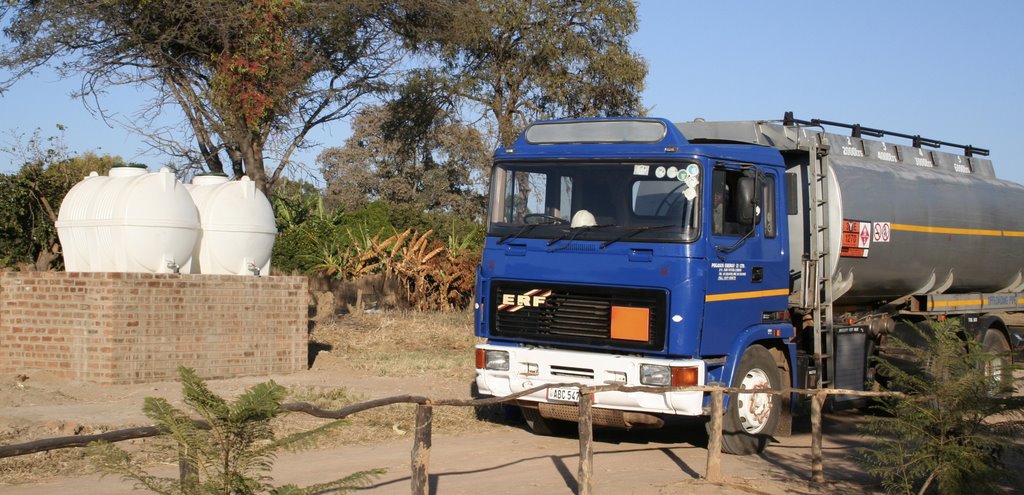
When the filling station in Kalomo closed its pumps, our nearest source for diesel was a 30-minute drive away in Choma. With the medical mission approaching, we had to find a better way to fuel all the vehicles that will be needed to transport 200 people into the bush for the clinics. We now have these two 2500-liter tanks across the road from our house.

The tanker truck shown above arrived early on Saturday morning to fill the tanks for the first time. Unfortunately, the drivers didn't have a pump to get the diesel from their tanks into ours. The two guys had to sit around all day while they waited for a pump to be sent from Lusaka. Around 5:00 in the afternoon they finally finished their task and went on their way.

Sunday, June 25, 2006

Everyday Heroes - John and Webster


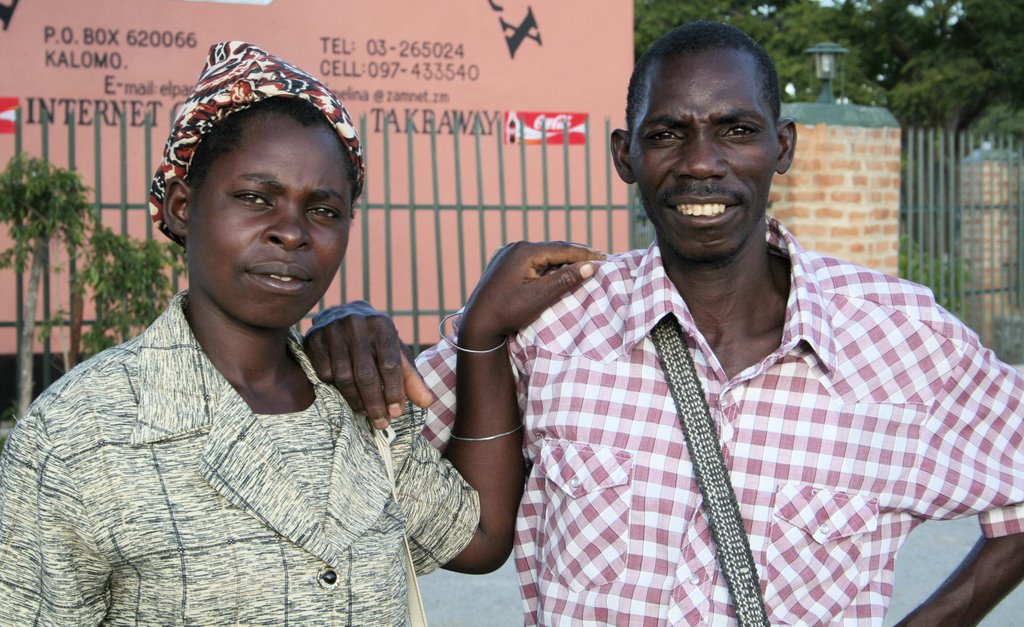
John (left) and Webster are standing with their brand new bikes. They will use these every weekend for their trips to preach at Msasa and Kemcas congregations. John and Webster have been going out every week for several months now, but they've had to borrow bicycles. Having their own wheels should make their lives a little easier. They earn the distinction of "everyday heroes" because it's a three-hour journey that they make every Sunday morning--one way.

Sandy, a doctor in Abilene, is another hero in this story. She contacted a large discount store and managed to get these bicycles and several more donated.

Saturday, June 24, 2006

One Year!

One year ago we moved to Namwianga. It doesn't seem possible that the time has gone so fast, and yet in other ways our life in the US seems long ago and far away.

We have grown and changed as we have learned to live in a different culture. The fears that haunted our first few weeks have disappeared, replaced by the confidence that comes with learning new customs and routines. Although we miss our family and friends from home so much that we ache for them, we have made wonderful new friends who love us and care about us.

Our faith has been tested, our patience stretched, our courage summoned. Through all our new trials and adventures, we have had an overwhelming, God-given assurance that we are where we should be, doing what we need to do. We have felt the support of our faithful friends and even people we have never met who regularly assure us of their prayers on our behalf. Our sponsoring congregation at Brentwood Oaks has been incredible in their care for us and their generosity in meeting our needs.

It hasn't all been easy, and we certainly haven't enjoyed every experience, but we do admit that we're really having a good time. I guess David says it best when he signs off on his e-mails with the phrase "Having fun in Africa." We're looking forward to the years ahead.

Wednesday, June 21, 2006

Medical Mission News

The second container arrived last week, to everyone's great relief. Ellie Hamby and Wil and Jenny Pippin are also here now, and preparations for the medical mission are well under way. Thank you for your prayers.

Kids with Heart

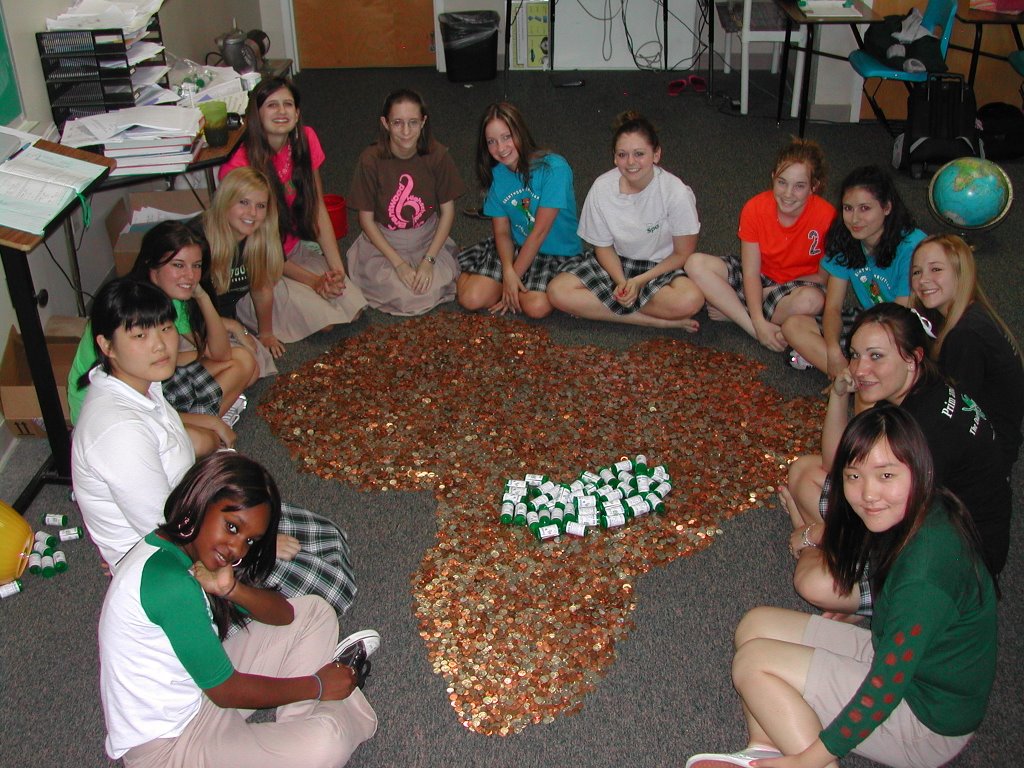
These girls are students at Brentwood Christian School in Austin where I taught for 17 years. BCS sponsored a Money for Medicines drive to raise funds to purchase drugs for the Zambia Medical Mission pharmacy. They distributed pill bottles full of M and M's (Money for Medicines). Students were asked to eat the candy and return the bottle filled with money. The 700 students in preschool through 12th grade raised over $9,000! As you can see in the picture, much of that amount came in the form of nickels, dimes, and pennies. The shape of Zambia in the middle of the "continent" is formed from some of the leftover pill bottles.

Friday, June 16, 2006

This Is a GOOD Family

“This is a GOOD family.” My father made this announcement with pride when all of us gathered for meals. He would wait for the designated pray-er’s final “amen” after the blessing. Then his face would beam as his voice boomed the words that reminded us that our family was special.

I have thought about my dad’s words these past few days. My older sister reminded me that she is the only one of the four siblings in the United States this week. My brother is directing a medical mission in El Salvador and my other sister is there working on his mission team. A nephew and two nieces are also there helping in this effort.

Mary, the one who remains in the US, has done her part by collecting supplies for both El Salvadoran and African mission work. Our daughter Sara will be here with us in just a few weeks to participate in Zambia Medical Mission. Aunts and cousins are helping to sponsor needy students here at Namwianga.

My father died in a farming accident in 1973. I’m sure he had no idea that one day his children would be spread around the world doing mission work. But he planted in us the conviction that we were supposed to be working for the Lord and making a difference. You can’t leave a better heritage than that. I’m very blessed to be part of his “GOOD family.”

El Salvador Medical Mission

Click on the above title if you are interested in reading about the medical mission that my brother, Ralph McClurg, is directing in La Palma, El Salvador.

What Would Martha Stewart Do?

We love having visitors from the US here at Namwianga, so we were looking forward to having a group associated Mapepe Bible School in Lusaka visit us last Sunday. Our good friends David and Lorie French were bringing their two daughters and a group of eight Americans from their sponsoring congregation. They planned to stay overnight on their way to do some sightseeing in Livingstone. Wil and Jenny Pippin and their son had arrived at Namwianga on Thursday, so we had invited them to come eat with this group on Sunday night. David had left on Saturday for his weekend outreach, but I thought he would be back by mid-afternoon on Sunday when the visitors were scheduled to arrive.

I got up early on Sunday morning to get started on preparations for the Sunday night meal. I baked a couple of cakes and made egg noodles before I left for church. When I came home and turned on the water tap in the kitchen, nothing happened. I tried all the other taps in the house—no water. Our tank was empty. I called around and found out that the rest of the mission had been without water for the entire weekend. At least I had had enough in the storage tank to make it until Sunday.

I did some math in my head. We had an extra Zambian houseguest, so I was expecting 18 people for dinner. Nine of those were to stay overnight at our house—and we had no water. I also had no vehicle since David was gone. It was time for creative thinking. I had the keys to Ellie Hamby’s house because some of the guests were going to sleep there Sunday night. Since no one had been staying there this week, I hoped that her tank might still have water. I got the wheelbarrow out and headed down the road. I filled up a 5-gallon Igloo at Ellie’s and brought it back to my house in the wheelbarrow.

The group arrived at 3:00. David and Lorie have water problems at their house, too, so the guests were very understanding as I pulled out wet wipes for hand washing. With the extra drinking water I had stored earlier and the five gallons from Ellie’s house, I managed to get dinner ready. We had a delightful time enjoying our meal together--but without David. He called at 7:00 saying he was still at least two hours out in the bush. The water finally came back on, to everyone's relief. We still had no hot water, because the water heater forms an air lock whenever it gets empty and refuses to work until the plumber comes to fix it. Lorie French pitched in and the two of us managed to heat water and get the dishes done. We got everyone situated for the night before David finally got in at 9:30.

Monday morning I heated water on top of the stove so people could have hot water for taking baths. We had another enjoyable time together at breakfast, and then the group took off for their day’s adventures. I breathed a sigh of relief—at least the electricity hadn’t gone off!

Monday, June 12, 2006

Chiili Church Planting

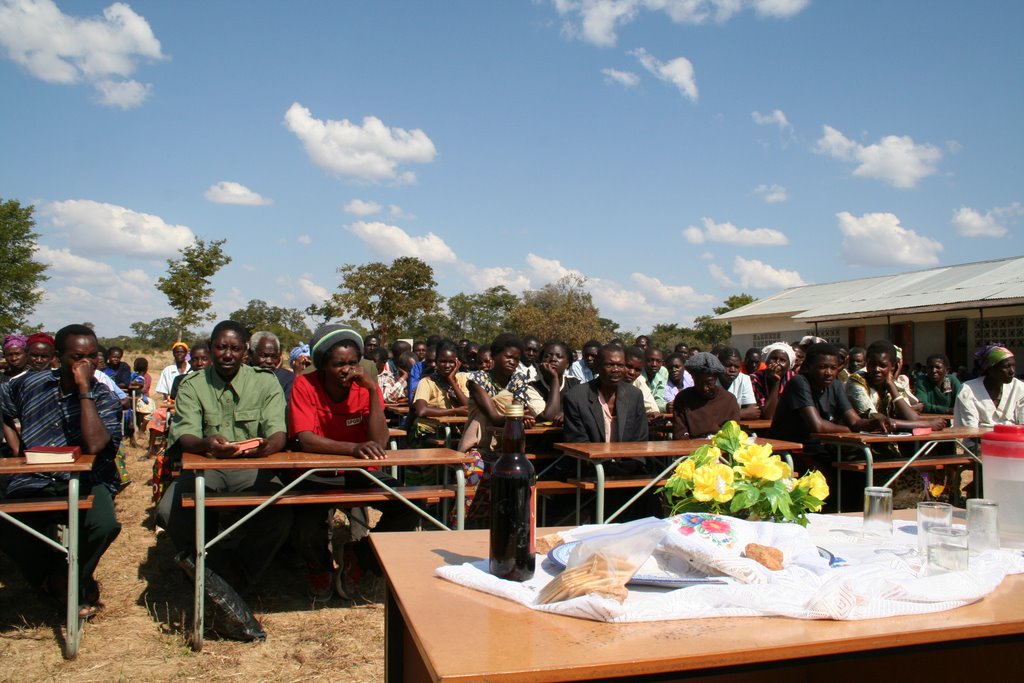
David returned from Chiili at 9:30 Sunday night with stories to tell! This photo shows some of the 300 adults and 111 children who attended the first meeting of the church at Chiili. The people were very receptive and enthused about a congregation being established here. There were four baptisms and nine restorations. From now on, Daniel Mweemba will ride his bicycle to Chiili twice a month to help develop the leaders and to assist the church in its infancy. It's a 37-mile trip from his home--one way. Please pray for Daniel, the new Christians, and the new church planted in this area.

Saturday, June 10, 2006

Weekend Outreaches

Last weekend two groups of students spent the entire weekend teaching and spreading the good news. The Helping Hands Club from the secondary school sent a group of 26 to Sandy Hill and the Heavenly Echoes Choir had 17 who went to Nazilongo. Both groups camped out Friday through Sunday, cooking their food over open fires. The Nazilongo group slept in a church building. Sandy Hill has no building, but the villagers built a grass fence with two areas, one for the men and one for the women. Each fence was three-sided, and on the open side each group had a big fire blazing to provide warmth. It was a COLD weekend, so they needed those fires while they slept under the stars!

The Nazilongo students went door to door in the area around the church building and invited people to come meet with them. They had preaching and teaching sessions on Friday and Saturday nights and on Sunday morning. The Sandy Hill group had preaching on Friday night, Saturday morning, Saturday afternoon, Saturday night, and Sunday morning. They also taught children's classes.

There were six baptisms and 37 restorations as a result of the weekend efforts. Both Nazilongo and Sandy Hill congregations begged for another camp meeting. Roughing it in the cold didn't seem to bother the students, as they all agreed that the weekend was a great experience and asked when they can go on another weekend outreach.

They won't have long to wait. Three camp meetings are scheduled for the last weekend in June. Please keep these efforts in your prayers.

Weather News and Notes

It's been COLD this week! We had several days when the morning temperatures were near 50 degrees. Our house, like all the others in the area, has only a fireplace for heating, and these concrete floors and walls stay cold. I've been wearing long underwear and sweaters to stay warm during the day, and David has been building fires in the fireplace on cold evenings.

One evening we stepped outside for a walk around the campus and heard the crackle of a fire. We could see the flames leaping 20 feet into the sky just a block or so away from us. We didn't see anyone running in panic, but we headed down the road to check out the blaze. Two houses in that area have thatched roofs, and we were also concerned about Sheri Sears's house. When we rounded the bend, we saw two men supervising the fire in a harvested cornfield behind Sheri's house. They had obviously set the fire and were watching it burn with no alarm.

The people in this area often harvest the corn, then cut down the dried stalks, pile them up, and burn them. We stopped to ask these guys why they were doing this at night. They told us that they wait for nightfall so that there is no wind and so they can see exactly where the fire is burning.

We continued our walk around the campus. Within 20 minutes the fire was reduced to embers.

Church Planting

Day Mweemba, son of Daniel Mweemba and brother of Victor, arrived at our house yesterday morning at 7:00. He had left his home in Kauwe at 1:00 a.m. and ridden seven hours through the night to deliver a letter from the headmaster of Chiili Basic School. Here’s what the letter said.

"The above mentioned man of God (Daniel Mweemba) visited this school over planting the church of Christ at this school. The meeting was well attended, because the school has (serves) 15 villages, and out of 15, 11 villages attended the meeting. This was a great achievement because the addressed congregation cried before him to plant one church at this school so that the lost sheep of God can be brought back. He also told the community members that on 10th June, 2006, you will be with us here. The people of Chiili are most welcoming you and very willing to see you on that day."

The headmaster and the chairman of the PTA had signed the letter.

So now it’s Saturday morning and David just pulled out of the driveway. The pickup is loaded with camping gear, Bibles, communion supplies, and a large container of water. He and Rodgers Namuswa will head north to pick up Daniel and another worker before heading even farther north into the bush to the village of Chiili. Tonight and tomorrow they will meet with the villagers for preaching and teaching about the message of the gospel and the establishment of a new congregation.

I can’t help but marvel at the letter. I wonder how many school principals and PTA chairpersons in the US would issue such an invitation? Truly “the fields are white unto harvest” in this part of Zambia.

Sunday, June 04, 2006

AIDS in Africa

FOXNews.com - AIDS Toll May Reach 100 Million in Africa - International News | News of the World | Middle East News | Europe News

Click on the title to read an article about the "deadliest epidemic in history." We see the devastation of AIDS all around us here. Some of our very good friends are HIV positive. Many of the sponsored students are orphans, with AIDS as a probable cause of many of the parental deaths. There is not a family in our community that has not lost someone to the disease. The gospel has an additional urgency in a culture where death is a constant presence.

Saturday, June 03, 2006

Containers, Part 4

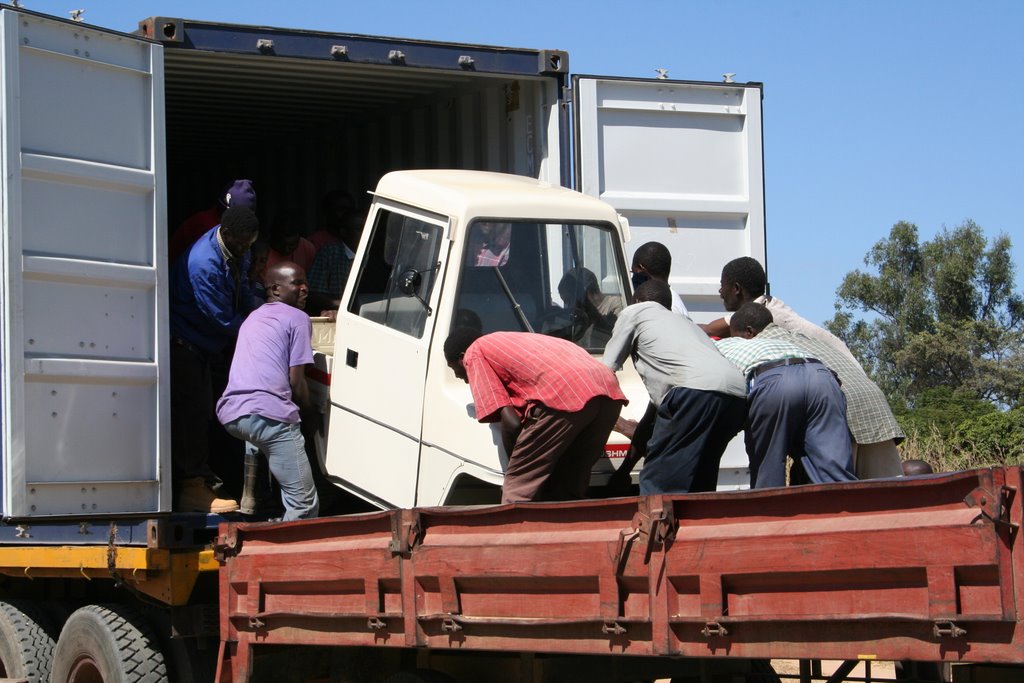
We felt like we were at the tower of Babel as guys speaking Chitona, Bemba, and Lozi all offered advice for getting this electric cart unloaded off the container. Finally it was agreed that the farm tractor should back a trailer up to the container. Then lots of manpower lowered the cart gently onto the bed of the trailer.

Containers, Part 3


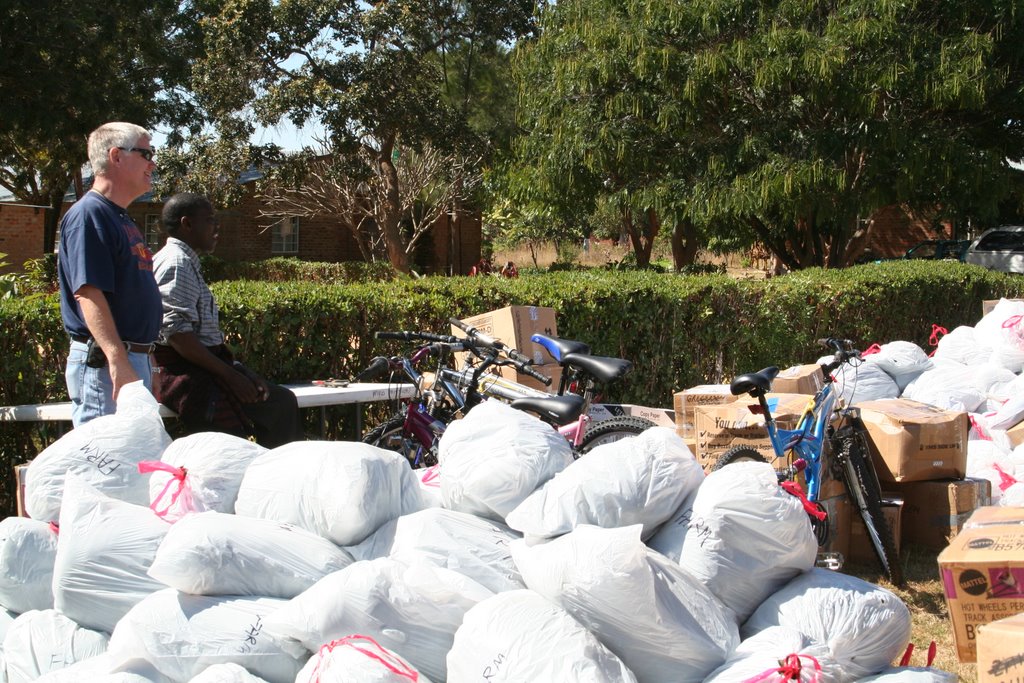
David surveys the stacks of supplies that came off the container. The white bags in the foreground hold sleeping bags; the bags in the background hold clothing. The bags of clothing are used to fill in the cracks between boxes and other items so that no space is wasted. The new bicycles will be used by church planters who fan out from Namwianga each weekend to teach and preach.

Containers, Part 2


Robby Banda (left), David, and Leonard Sichimwa pose in front of Container 2 right after its arrival on Friday morning. Robby and David spent hours on the internet and cell phones getting the container cleared. Robby even made a one-day trip to Lusaka to deliver the paperwork so that there would be no delay at the border. Leonard Sichimwa is the chief cook for the medical mission and is in charge of getting all the contents of the container put into the right places.

Containers, Part 1

Containers shipped from the US provide many of the supplies that are critical to ministries at Namwianga. These containers are the size of railroad boxcars. At least one is shipped from Abilene to supply the medicines and foodstuffs for the annual medical mission. Usually another one or two containers come over in the course of a year filled with other supplies for the clinic, schools, and other departments.

Each container moves by truck from Abilene to a port on the Gulf of Mexico. Then it sails by ship to a port in either South Africa or Tanzania. There the container must clear customs and then be loaded onto a truck for its final journey to Namwianga. Every border crossing requires another customs clearance. This odyssey usually takes about two months and is often filled with bureaucratic red tape and complications.

That was certainly the case this year. The container (hereafter referred to as Container 1) for the medical mission was shipped out of Abilene in January bound for the port of Durban in South Africa. A second container (Container 2) with miscellaneous items was shipped a month later and scheduled to enter Africa at the Tanzanian port of Dar es Salaam.

When neither container had arrived by May, the quest to locate and get them moving began. Ellie Hamby in Abilene, an agent in Houston, and mission superintendent George Phiri all began sending e-mails and making phone calls. Of special importance was Container 1 since it held the supplies for the medical mission in July. It also had most of the food that was to be used for a separate effort, the Northreach Medical Mission scheduled for June 1-12. Eventually the container was found to be sitting in a shipyard in Durban where it had been since mid-March awaiting clearance by customs. Containers are allowed only a few days for this process, so now a fee of $2000 in storage charges was levied. The Mission was not technically responsible for the delay, but there was no way to get the container moving without making the payment, so the money was sent. Still the container sat.

Northreach Medical Mission gave up on the container arriving in time for them and began buying up other foodstuffs and making alternate plans. Phone calls and e-mails kept flying with repeated assurances coming from an agent in Lusaka that the container was about to move. Each time the claims turned out to be false.

On Sunday night, the directors of the Zambia Medical Mission met to formulate Plan B. They decided that if Container 1 does not arrive by June 19, the medicines for the mission will have to be purchased in the US and shipped by air to Zambia at a cost of over $50,000. They put out a plea for everyone to pray for Container 1 to get moving. Meanwhile, on this side of the Atlantic we had already been praying about the issue. David and Robby Banda, the Mission’s financial officer, had started to work on the containers. They began using the internet to locate officials and offices in the chain of responsibility, and they started making phone calls. They were working on both containers: trying to locate Container 1 and get it moving and also making sure that Container 2 was able to clear customs in Dar es Salaam and at the Zambian border.

The logjam seemed to break loose this week as both containers cleared customs in their respective ports and began the journey by truck to Namwianga.

Container 2 has now arrived, pulling into Namwianga on Friday morning at 10:00--one down, one to go. Although we feel very hopeful at this point about Container 1, we won’t be able to celebrate until it arrives and we have the medicines we need here at Namwianga. Please keep this in your prayers!

Wednesday, May 31, 2006

Goodbye, Baby


On Sunday mornings and Sunday nights I get my weekly “baby fix.” Kathi Merritt is my supplier. Maybe I’d better explain that a little. Kathi and husband Roy run “Eric’s House,” a home for adolescent boys. Most sane people would consider that enough of a challenge, but not Kathi. When the baby orphanage across the road from Eric’s House filled to overflowing, Kathi brought six of the toddlers over to live with her big guys.

I’ll admit that I thought she had lost her mind. However, after a few visits I saw her wisdom. Those teenage boys love having those little ones around. They carry them, play with them, and hug on them. And the toddlers look with adoring eyes at their adolescent pals. As Kathi says, it softened the atmosphere. A winning combination all around. Shown in the photo are Molly, Sterling, Kingstone, Stanley, Newton, North, and Eunice.

On Sunday mornings and Sunday nights, the bus from Eric’s House pulls up in front of Johnson Auditorium and the gang of large and small bodies pours out and heads for the pews. I try to be ready and waiting to grab one of the little ones for my lap. Ostensibly, I’m helping Kathi out so she doesn’t have so many to worry about during church. But the real reason is that I need some time to love and hug on one of those cute little guys!

For the past couple of months Kathi has usually handed me North or Newton. These handsome boys are half of a set of quadruplets. One of the quads died at birth, the parents kept one of the babies, and North and Newton went to the orphanage at Namwianga until Mom and Dad could handle having all of them.

By Zambian standards North and Newton are extremely active. The other toddlers are usually content to sit quietly, turn the pages of the songbook, and eventually fall asleep in my lap. Not North or Newton. They grab my glasses, my earrings, and my nose every time they get a chance. They want to shred the songbook, not turn the pages. And sleep? Out of the question when there is so much to see and do. I love every minute, but I admit I am tired when the service is over.

But then came the time when North and Newton were to go home. Their mom and dad spent a week at Roy and Kathi’s to make sure that the boys, the parents, and the other quad (a girl) bonded. Rough-and-tumble North and Newton had lessons to learn from their smaller sister. She let them know right away that she was not one to be tampered with.

Last week I held Newton on my lap on the Sunday night before he was to leave with his parents. We started out in the usual way: he pulled my glasses, yanked on my earrings, and tried to mutilate the songbook. I gently put a stop to all that with a big hug. He sat still for just a couple of minutes, and then—miracle of miracles—his eyes got heavy and he fell asleep. I watched his handsome little face as he lay relaxed in my lap and savored every moment. I took his little black hand in my white one and marveled at the beauty of his fingers.

Church ended, but Newton slept on. I gently repositioned him on my shoulder and carried him out to the Merritt’s bus. “What shall I do with him?” I asked Kathi.

“Well, his dad is right behind you. He’ll take him.”

So I handed off my little warm bundle. I gave Newton one last kiss on his head.

“Goodbye, little guy,” I whispered, swallowing the lump in my throat.

My head knows that it’s a good thing for him to be with his sister and parents. My heart (and my lap) will need awhile to agree.

Saturday, May 27, 2006

Katakula Marriage Seminar

Last Saturday we conducted a marriage seminar at Katakula. This group has only been meeting for two years now. They built this mud and thatch enclosure themselves. This structure is unique in that it has been painted and decorated. The outside has scriptures and a few pictures painted on it. Inside, the walls are lined with scripture references. Note in the picture that everyone has to duck to enter.

The benches inside are made of brick plastered with clay from termite mounds. There is seating for 80. We had close to 100 in attendance for last week's marriage seminar, so people were sitting on small stools and on the floor all around the speaker's podium.

Harvest

Zambia is below the equator, so our seasons are the opposite of those in the USA. Right now we are enjoying autumn. The temperatures are cool--even downright cold-- at night and in the morning. The afternoons are warm, but when the sun goes down we grab our sweatshirts and fleece jackets.

Everyone is busy harvesting the maize crop. The rains were good this year, and most people have a bountiful harvest.

David is shown here in our maize field. We went in on shares with two other farmers. Our crop will be used to feed the hungry and provide seed for next year's planting season.

Campfire Bible Study

The Sandy Hill congregation is only a few months old. We have been going there on Sunday afternoons since March to help them get a good start. Recently they asked us to come teach a Bible study on Thursday evenings.

David gathered up several men from Namwianga to go with us and we set off just at dusk. By the time we reached Sandy Hill Farm, the sky was completely dark. The winding road into the workers’ compound seemed even narrower at night. As the rays of the headlights lit up the first few houses, we saw children running to greet us. They waved their arms and shouted in Chitonga, “Church! Go to Church!”

Barefoot boys and girls continued their shouting as they ran behind the vehicle to the far edge of the compound where the church meets. One of the leaders had built a fire for us to gather around. The children rushed to their places nearest the fire while a few adults brought “mudala” stools and joined them. The church leader assured us that others would come when they had finished eating their suppers. As we waited, the children sang a few songs and then listened with rapt attention as David told them the story of the little boy who shared his loaves and fishes.

The fire roared on as others trickled in to join our gathering. In the dim light of the fire we could only see the faces of those who were nearest the flames. Others were faint outlines against the night sky.

David’s lesson was entitled “Who Is God?” He began by having everyone memorize and recite James 4:8 “Draw near to God and He will draw near to you.” We all repeated the verse in Chitonga several times during the course of the lesson. Many Zambians cannot read, and even those who do read may not have Bibles, so David tries to emphasize memorization of scriptures. He continued the lesson using the stars as a visual aid as he talked about God’s creative power.

One little boy about eight years old was seated in the dust about three feet away from David and me as the lesson began. Little by little he inched his way over closer to us. By the end of the talk, he was right in front of us, his head resting on David’s leg.

The lesson concluded. The smoke of the fire rose to the night sky as our closing songs and prayers rose to the God we serve. We climbed back into the truck for the trip home, promising the leaders we would return next week.

This kind of campfire teaching is a highlight of our work here. As David said on the way home, “It just doesn’t get much better than this.”

Wednesday, May 24, 2006

Would You Like Fries with That?


Victor and Obrien, our young friends who are attending Kabanga Christian High School, spent a month with us in April during their school break. They asked if they could stay here and work while they studied for the exams that they will take at the end of their ninth grade year in December. During the first two weeks, they took a special preparation course at Namwianga Basic School. The last two weeks they worked in our garden and did odd jobs during the day. Throughout their entire visit, they were diligent in their studies. Every evening after supper they washed up the dishes and then retreated to their room where they studied until bedtime. I often found them already up and studying early in the mornings as well.

It wasn’t all work and no play, however. We took them with us on a trip to Livingstone one Saturday where they got to see the Victoria Falls and eat in a restaurant. They also hung out with some of their Namwianga friends and went with us on weekend outreaches.

Just before the new term began, we provided bus fare for them so that they could go spend a few days with their families. Victor headed north to see his parents, while Obrien visited his grandmother in a village near Kabanga. Victor stopped by on his way back to school and brought gifts of appreciation from his parents. Besides this live chicken, they sent peanuts, a large pumpkin, and another type of wild nuts.

I wasn’t quite sure what to do with the chicken, although I appreciated the gift very much. Right now chickens sell for $6.50 each, so it was a generous gesture. My good-hearted neighbor, Mrs. Moono, came to the rescue. She inspected the chicken and pronounced it too skinny for eating just yet. She took it home with her for ten days to fatten it up, and then she killed and dressed it for us. (She raises broilers to sell and is shown here with one of her own.)

We shared a pot of chicken and noodles in appreciation.

Saturday, May 20, 2006

Everyday Heroes

This is the first of what I hope will be a regular series on the blog. One of the most encouraging things about our work here is encountering people who live ordinary lives with extraordinary faith and commitment. I call them everyday heroes.

Maxson, shown here with his wife, is the night watchman at the Namwianga Guesthouse. We first met him when we lived there last July and August. He would be bundled up against the cold as he sat in the small, detached laundry room outside the back door. David noticed that Maxson was always reading the Bible. He began having occasional talks with Maxson and shared inspirational reading material with him.

As it turns out, Maxson lives more than eight miles away from Namwianga. He rides his bike here after dark every night and leaves just after dawn every morning. He uses his nighttime hours for Bible study to help him in his role as a church leader in one of the newer congregations north of Kalomo.

We’ve been on a couple of outreaches with Maxson and his wife. Watching him teach and preach gives new meaning to the phrase, “On fire for the Lord!” When he leads singing, he leads not just with his hands, but with his entire body. He radiates an enthusiasm for the Lord that is obvious to everyone he meets.

People like Maxson are the everyday heroes who help make Namwianga Mission a beacon of light in southern Zambia.

Tuesday, May 16, 2006

Snake! Snake!


Linda and I took a walk this evening just before the sun went down. As we walked, I told Linda, "We've been here eleven months and we haven't killed a big snake in our yard yet. I thought we would have killed four or five by now."

Around 7:30 p.m. I had just finished washing the dishes. As I looked out the kitchen window I could see our cat lying on the ground just past the back veranda steps. I called to him a few times, but he seemed preoccupied. When he finally moved to come into the house, I saw the object of his attention. Apparently the cat was stalking and getting ready to attack this cobra. I guess I blew the cat's cover.

I took this picture of the cobra seconds before our neighbor Jeremiah Moono, famed Namwianga snake killer, put an end to it. Jeremiah snuck up behind the snake, gave it one mighty whack on the head with his specially designed snake-killing stick, and then speared it to the ground. The cobra measured over a meter long.

Another Africa adventure that the Zambians handle as an everyday occurrence.

By the way, I have already ordered one of those snake-killing spears.
Jeremiah says they make them in the villages for about 98 cents.

Having fun in Africa,
David

Friday, May 12, 2006

Mother's Quilts

In honor of Mother's Day, I am sharing a tribute I wrote about my mother, Ruth McClurg.

The quilts tell her story. I finger the bright prints and smooth the muted solids. I trace the stitching on intricate designs or snap a simple nine-patch design over a bed. And when I do, each quilt whispers her story.

I asked my mother many times to tell me her story. Usually she refused to offer more than the briefest of details. “Not much in my life,” she would say, “is worth telling.” So I am left with the quilts—the bits and pieces of my mother’s story.

Like the quilter who stitched them, the quilts are sturdy. The stitching speaks of one who can endure repeated trials without coming apart. Mother’s trials were all too many. She was raised in a crowded household by a preoccupied and distant mother. The reality of the depression was a constant presence on the Iowa farm. Mother loved learning and longed for a good education, but there was no way to get into town for high school, so she was forced to quit school at age 13. She married at 21 and worked with my father on the farm from sunup to sundown. Farm life was a constant struggle against the capricious whims of drought and crop failure. There was never more than just enough money to get by. When she was a young mother, her brother committed suicide and her sister’s only son drowned. When Mother was in her fifties, my father was killed in a tractor accident, leaving her with a farm and a construction business to run by herself in addition to her job as a nurse’s aide. Just a few years later her infant grandson died of a rare illness. Through it all she remained strong and uncomplaining. Only sturdy women like my mother endure the bits and pieces of hardship and pain without bitterness.

The bright hodgepodge of prints in her quilts tells of one who was frugal. Mother used only scraps of fabric for her quilts. Others might plan and purchase colors and prints for a coordinated palette, but Mother was content to use what she had. “Make do or do without” was a proverb she lived by, first of necessity during the long years of the depression and the lean years on the farm, and then from sheer habit. So her quilts are pieced from leftover fabric, from fabric others gave her, from the good pieces saved from discarded garments. One of her most beautiful quilts was stitched on white blocks that were cut from my father’s white dress shirts after he died. In her later years, she promised that when she had sewn up all the scraps she had, she would go out and buy fabric like the modern quilters did. I knew that day would never come—and it didn’t. After her death my sisters and I found boxes of fabric scraps ready to be sewn into quilt tops.

Two of Mother’s quilts were made especially for my children. Sara’s is a beautifully pieced and embroidered “Sunbonnet Sue” pattern put together with strips of pink. John’s quilt pattern is called “Bow Tie” and is pieced with bright blue. Both quilts speak softly to me of Mother’s love for children. No one could name all the little ones who came in and out of her life. When the depression forced her to quit school, she became a hired girl for families in her Iowa community. She would go to their homes and help out when the mothers had their babies. Later she married and had four children of her own. A nephew needed a home, so he was added to our family. Still there was room for more, so she and my father became foster parents. Through the years 14 different foster children called her Mama. After my father died, she became a relief housemother at a children’s home and became “Grandma Clurg” to hundreds of other children who needed warm hugs, loving smiles, and gentle words of wisdom. Each child was precious to her—bits and pieces added to her heart.

I’m not sure how many quilts my mother made in her lifetime. Only a few were truly works of art. The rest were pretty to look at, but made for service. “My quilts aren’t beautiful,” Mother would say, “but they are meant to be used!” Such service is a part of Mother’s story as well, for she loved to help others. She prepared countless meals for family, guests, and church potluck dinners. At any family gathering, we expected to find Mother in the kitchen washing dishes or quietly finding a way to clean, straighten, or make someone else comfortable. Mother had no desire to stop serving as she aged. After she left her position at the children’s home, Mother became a private duty nurse. She finally retired for the last time when she was 70 and began her volunteer work at the community hospital, accumulating hundreds of hours of service. In her younger years she taught Sunday School classes, and in her later years she was a regular helper in Vacation Bible School. When her 80th summer approached, my sister and her husband invited Mother to go with them on a road trip through the northwestern states. Mother was disappointed that the trip caused her to miss helping with Vacation Bible School. Yes, like her quilts, Mother was created to serve.

Not all of mother’s quilting became bedding. She used some of her scraps to make potholders. Those potholders remind me that much of Mother’s life was spent in the kitchen. She was known in our family and our church for her cooking skills. She seemed to put a delicious meal on the table with no effort at all. Her cream cheese mints, hot rolls, and chocolate chip cookies were her trademarks. My daughter once asked her, “Grandma, why do your chocolate chip cookies taste so much better than anyone else’s?” Mother’s immediate reply was, “Because there’s a little love in every bite!” Even as a widow living alone in a small house, she kept her freezer stocked full of food ready for company. Her death came just 12 days before Christmas in 1998. We were not surprised to find that the Christmas dinner for the family was already there in the freezer: the turkey, the pies, the rolls, the vegetables, and, of course, the chocolate chip cookies, with bits and pieces of love in every bite.

Not all of the stories in Mother’s quilts are hers. Each family member has stories told by the quilts. We love to admire the quilt tops and take turns pointing out, “I had a shirt out of that!” or “That was my Easter dress!” We recall first days of school, dates, bedroom curtains, school trips, and 4-H projects. My niece is a young adult now, but she claims the quilts can transport her back to her childhood. She says, “It's always amazing to me that looking at a tiny scrap of fabric on a quilt can evoke such deep emotions. I can see a quilt piece and remember the exact outfit made from that fabric. Suddenly I feel like I'm 10 years old again, wearing that outfit and heading to church or going to school.” Mother’s quilts tell the bits and pieces of our lives, too.

Mother took the random bits and pieces of her circumstances and stitched them into a life that was loving, sturdy, frugal, and serving. God’s hand placed the final stitches. With timing as loving and kind as Mother’s sewing, He gave Mother’s life a gentle goodnight. Surrounded by family and at peace, she died as she had lived—quietly and lovingly.

There will be no more quilts made by my mother’s loving hands. But we will still discover more of her story and ours. The quilt of Mother’s life lives on, warming our hearts just as her handmade quilts warmed our bodies, and reminding us of the bits and pieces of a life well lived.

Copyright pending
Patience Taxed and Rewarded

On Wednesday we decided to make attempt number SIX to pay the road tax. We were low on cash and needed to use the ATM, and we had some errands to run, so we could justify making the trip to Choma.

It was 10:15 when we arrived at the bank. Our plan was for me to get cash at the ATM while David went inside and paid the tax. David waited in line for 15 minutes to get up to the window under the sign "Road tax payments accepted 10:00 - 12:30 only." The clerk behind the glass window informed him that the one person in the entire bank who could accept road tax payments "stepped out." David asked when she would return and the clerk said, "I don't know."

When he returned to the car with this news, I told him we had probably already spent more trying to pay the tax than the fine for non-payment would cost. We decided we would just continue to stop by when we were in the area, but we would not make any more special trips.

Meanwhile, I had found that the ATM was not working. The security guard said it was being repaired and to try again tomorrow. This bank has the only ATM in town. The next one is another two hours up the road toward Lusaka. It was shaping up to be another patience-inducing day in Zambia.

We ran errands and did some shopping. At 12:15 we drove by the bank on our way out of town. "One more try," David said. As we pulled into the parking lot, I noticed a line at the ATM—it was working again. I told him I would get cash while he attempted to pay the tax. We both emerged triumphantly 25 minutes later. David had paid the tax and I had cash!

The single damper on our joy is that the bank only had tax forms for one quarter. We have to start this all over again in July.

Thursday, May 11, 2006

Kalomo Hospital


On Thursday afternoons Rogers Namuswa and I visit the Kalomo Hospital to share encouragement from the Word and to pray with the patients and their families. Back in the US, I frequently made hospital visits, but this is a very different experience.

The hospital building itself bears little resemblance to the sterile, high-tech facilities in America. The walls are constructed of painted cinderblock. Light bulbs attached to bare wires hang from the ceilings. The floor is bare concrete. The old metal beds have foam mattresses that make church camp beds seem luxurious by comparison. Patients must bring their own bedding. There are no screens on the windows to keep out the flies and mosquitoes. There are no fans or heaters.

One doctor and a few nurses are assigned to hospital. There is also one grey cat that visits each ward.

A courtyard separates the two wings of the hospital and a breezeway serves as a hall between the two wings. There are three large open rooms on each side of the hospital with ten to twelve beds in each room. When there are not enough beds, patients are assigned to foam mattresses on the floor of these wards. Somewhere there is an operating room, but I haven’t wanted to see it.

One side of the hospital is for children and for pregnant mothers waiting to deliver. The children’s ward is the most heartbreaking to visit. Last week three children were especially hard to see. Two brothers ages two and four were suffering from drinking a weed killer used on cotton plants. The youngest was unconscious, breathing laboriously. The older brother just lay on the bed, watching our movements through tired eyes. The third child was a girl about eight years old. There was a large open wound about four inches long on her right forearm. A nurse explained that the girl lives in a mud and thatch hut with no solid door. She sleeps on a mat on the floor. One cool night a cobra seeking warmth slithered next to her warm body. When she stirred, the snake bit her arm. The venom caused necrosis, the death of the skin and tissue around the bite. I prayed that the boys would survive and that the girl’s arm could be saved. I cried out to the Lord for what I often hear the Zambians ask of Him, “Leza (God), be the final medicine.”

Our purpose for these visits is to be Christ’s voice of comfort to suffering and dying people who live in a harsh land. We encourage them to be strong in faith even though their bodies are weak. And we always cry out to God, “Leza, be the final medicine.”
David

Wednesday, May 10, 2006

News and Notes - May 10

It's autumn in southern Zambia. The rains ended in early April, and we will not have any significant precipitaion again until late October or early November. The roadsides have already turned brown, and we are having to water our garden until we get our new drip irrigation system up and going. The temperatures are cooling off as well. The mornings and evenings are crisp and just cool enough for a sweater or jacket. Daytime temps are in the high 70's. Just about perfect, if you ask me. The Zambians predict a very cold winter because we had such a wet rainy season.

We made another attempt to pay the road tax on Monday. Robby, the Mission's finance officer, had banking business in Choma. He thought the Road Department accepted tax payments and agreed to go by there and take care of it. He did go by the Road Department but found that the office in Choma is not set up to accept road tax payments. The saga continues.

Monday, May 08, 2006

Speaking of Marriage

On May 1 David and I celebrated our thirtieth wedding anniversary. That sounds like such a long time, but it seems like only yesterday we were standing at the front of the Downtown Church in Searcy, Arkansas, reciting the vows that we wrote ourselves. It was the era of do-it-your-way weddings, daisies, and long hair. We left for our honeymoon in a 1971 Volkswagen Beetle.

In the thirty years since that day, we have been through much more than we could have imagined on that spring evening in 1976. We stood together by the bedside of our infant son as he died. We weathered the storms of financial difficulties when we couldn’t sell our house during the 80’s oil bust. We held each other in the night and prayed fervently through the years our children were teenagers. We faced the challenges that are inevitable in 27 years of full-time ministry. We survived the stress of getting graduate degrees. And now we are off on this adventure with the Lord in Africa.

Through it all we have been sustained by a deep love for each other, our ability to laugh at ourselves, and, most important of all, our shared love and commitment to our Lord. Over and over His faithfulness has carried us through our difficult days and provided just what we need.

There were the high points as well. The births and the adoption of our children will forever be etched in our memories as times of inexpressible joy. Dear friends sustained us through our hard times with loving acts of kindness. Our parents and siblings have been wonderful blessings to us. Our careers in teaching and ministry have allowed us to see God actively at work in the lives of others. The tough times we experienced mellowed us and made us much more fit for God’s service.

All in all, our thirty years have been richly blessed. We look forward to many more.

Marriage Seminar

Here is a picture of us conducting a Marriage Enrichment Seminar on Saturday. Note the angle of the chalkboard in the background. It's a pretty typical Zambian sight.

This seminar at Siabalumbi was our second; we did our first one at Boma three weeks ago. Ruhtt Mbomwae recruited us for these. She and her husband Shepherd work with several local congregations, and they plan an annual marriage seminar at each one. The seminars are scheduled on Saturdays in April and May. She told us that David was to speak on the role of a Christian husband, I was to speak on the characteristics of a Christian wife, and the two of us were to speak on communication.

We effectively put off our preparation for the first seminar until the last possible minute. There seemed to be a good reason for this: what in the world did we know about marriage in the Zambian culture? Most of the American advice we had been given about marriage seemed irrelevant. For instance, we were always told that we should make time for each other by having a weekly night out. Hmm. Where would a Zambian couple go for a night out? No car, no restaurants, no movie theaters. Most Zambians don’t even own a flashlight for a moonlit stroll! What could I possibly say that would help a Zambian woman in her role as a Christian wife?

David was ahead of me in preparation. He left on the Friday night before the first seminar to speak at a nearby congregation. I had to stay home, I told him, because I hadn’t prepared my lesson for the next day. The house was quiet. I closed all the curtains and locked the security doors so no one would know that I was home. I sat down in front of the computer with my Bible in hand and faced the facts. I was going to have to strip away all my American cultural views of marriage and go straight from the word of God. Once again, as I have done on a daily basis in Zambia, I prayed for wisdom.

Not surprisingly, the lesson developed easily. There is plenty in the Word about how a husband and wife are to treat each other. Love, honor, respect, and kindness know no cultural boundaries. I found I had plenty to say—straight from the Bible.

Both seminars we have done were well received by our Zambian audiences. The questions that participants asked, for the most part, revolved around issues that couples in all cultures face. And, not surprisingly, God’s word offers the needed guidance.

This experience humbled me and drove me to my knees in repentance. How often have I let my American cultural expectations and worldly wisdom guide my behavior and even my teaching? Living in a different culture is revealing to me the realities of Christian faith—without all the trappings of materialism and secularism that dominate American life.

Saturday, May 06, 2006

More on Patience

I found this definition of patience by John Piper and felt it was worth sharing. We have it posted in our kitchen: Patience is being forced by circumstances to go to an unplanned place of obedience, going at an unplanned pace.

We face the "unplanned pace" part of patience almost every day. Kelly Hamby and I used to joke that in Zambia, events move at the speed of cold molasses. Those of you who know me well can understand that I have had to make some adjustments to live this way. God has blessed me by helping me walk at this unplanned pace, and I am grateful. I am also blessed by the example of the Zambian people who live very patiently in a sometimes harsh land.

Here is the latest installment in the continuing saga of our attempts to pay the road tax. We found out that the road tax can be paid at the bank in Choma. Our friend Andrew was headed to Choma on Thursday, so we sent money with him so that he could go to the bank and pay the tax for us. He arrived at 1:30 and found that they only accept road tax payments in the morning. The lessons on patience continue--at an unplanned pace.

Friday, May 05, 2006

DDT--Weapon of Mass Survival

Click on the title above to read an opinion piece about a change in policy on the use of DDT to combat malaria in subSaharan Africa . We see the terrible effects of malaria regularly here. Our Zambian friends are often miserably ill for days. One man who worked for us lost a three-year-old son to malaria. We missionaries have a healthy fear of contracting the disease and take preventives with serious possible side effects to avoid it. Let's hope that the new steps proposed by USAID will ease the death and difficulty malaria brings to this part of the world.

Thursday, May 04, 2006

Learning Patience

David and I often marvel at the patience we are learning day by day. One either learns patience here or lives in constant frustration. We’ve opted for learning.

Our latest tutorial on patience involves paying the road tax for our vehicle. The tax payment provided by the Toyota dealership expired May 1. Proof of tax payment is a sticker on the windshield. David was told that he could pay the tax and get the renewal sticker at any local post office. So on the afternoon of Thursday, April 27, we made a trip into Kalomo to take care of the payment. The Kalomo postal worker politely informed David that the post office was short-staffed and no longer accepted road tax payments. The nearest post office that would accept payments is in Choma, he said. Now David had just returned from Choma that morning, so this news was not welcome. Choma is 30 miles away, and since we pay $5.65 per gallon for diesel, we try not to go too often.

But what choice did we have? The tax had to be paid. On Friday, April 28, David made another trip to Choma. There the weary postal worker informed him that his office had been out of stickers for two weeks. Go to Livingstone, he said, to the Road Traffic Department. David explained that there was no way he could make the 120-mile trip to Livingstone before May 1. The clerk advised him to prepare a letter deatailing the efforts that had already been made to pay the tax and take the letter to the police for an official stamp.

Monday morning, May 1, we headed out for a two-day trip to celebrate our anniversary.
We stopped by the Kalomo Police Station and got our prepared letter stamped, promising that we would go to the Livingstone office the next day. We actually drove through Livingstone that morning, but May 1 is Labor Day here and an official holiday, so the Road Traffic Department wasn’t open. We headed on toward our destination of Sesheke on the Namibian border.

Tuesday, May 2, we finished our shopping on the Namibian side and headed back early so we would have time to visit the Road Traffic Department and get the tax sticker. We pulled into the parking lot right at 4:00, congratulating ourselves on making such good time. David went in to make the payment. At 4:04 he was back at the vehicle. It seems that the Road Traffic Department computers shut down at 4:00 each day. We were two minutes too late to get our sticker.

I guess the road tax will get paid eventually. Until then we’ll carry our police-stamped letter, hope for the best, and be thankful for all the patience we’re learning.

Friday, April 28, 2006

Tons of Fun

It's snack time for Billy, and she insists on having her two bottles of WARM milk every day. (Billy won't drink cold milk.) Sheila Siddle is happy to oblige; after all, she's been taking care of Billy since the baby hippo was just five days old. Hunters shot Billy's mother. Some wildlife rangers found Billy all alone and brought her to Sheila at the Chimfunshi Wildlife Refuge. Sheila bottle fed Billy, and the hippo decided that Sheila would do just fine as her mother. Billy soon became good friends with the dogs on the farm and began following them into the house at night where she liked sleeping on the leather sofa and chewing the cushions if she got hungry. Eventually Billy grew too big to be in the house, and now she lives on her own out in the wild. But she still comes back every day for her two bottles of milk and a big tub of fruits and vegetables. During our visit Billy also jumped in the pool and enjoyed a a long soak.

Chimfunshi Wildlife Orphanage


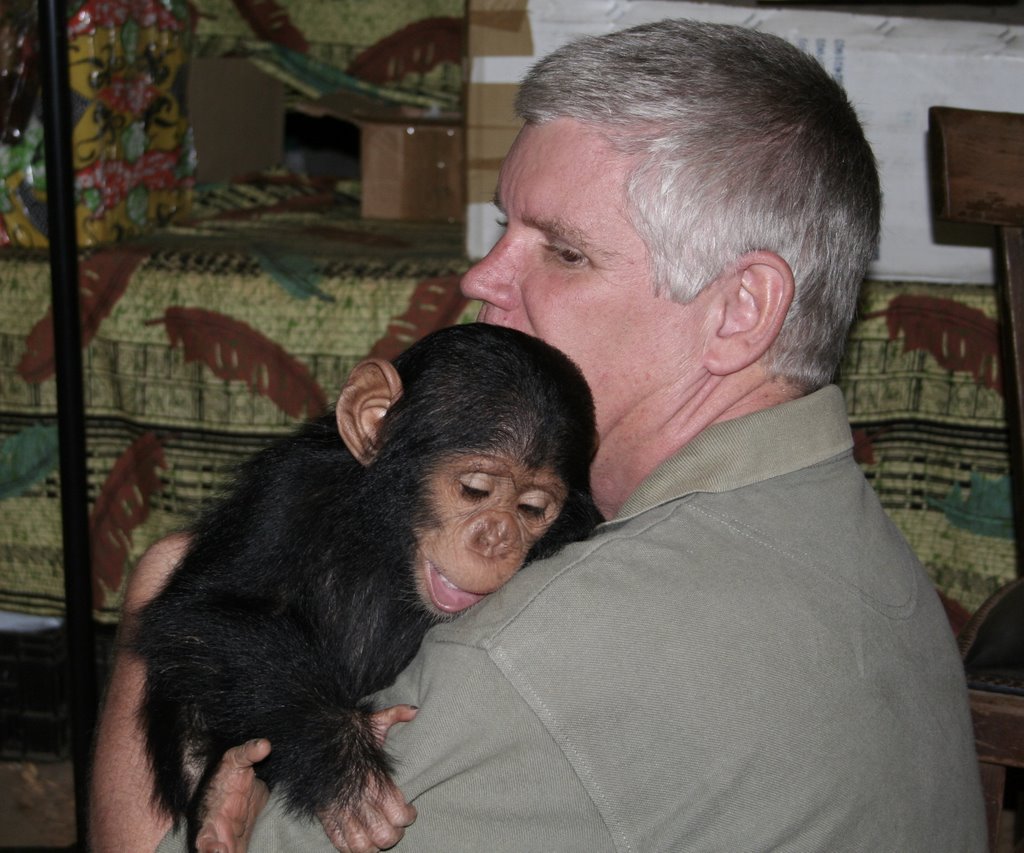
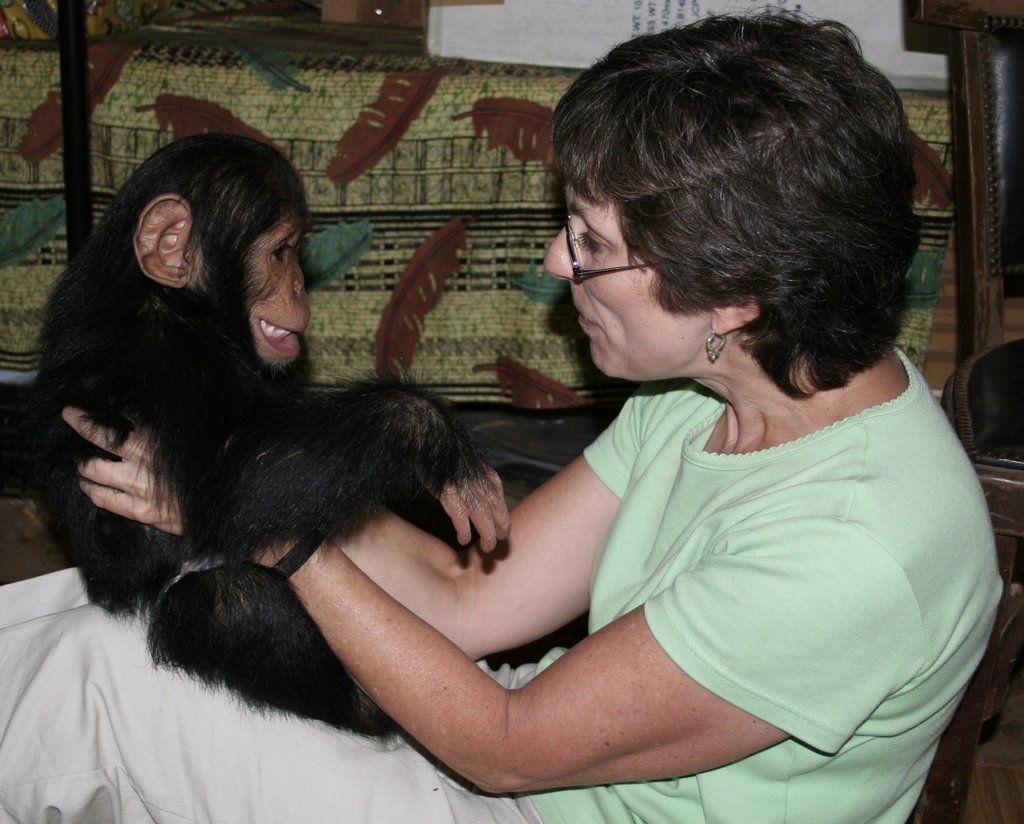
DeeDee is an adorable nine-month-old chimp who played with us during our visit to Chimfunshi Wildlife Orphanage. Like the other 110 chimpanzees at Chimfunshi, DeeDee was rescued by Sheila and David Siddle, the owners of a farm that has become a refuge for animals that are sick or lost. DeeDee lives with the Siddle's daughter and is treated very much like a human baby. She drinks from a bottle, wears diapers, and sleeps in the same bed with her human caregiver! As you can see, DeeDee makes friends easily and seemed to enjoy showing off for us by swinging from my hands or cuddling on David's shoulder.

DeeDee needed to be rescued because the alpha male in her group rejected her. Many of the other rescued chimps have sadder stories. Two chimps were deserted in a zoo that closed. They were found locked in their cage, wading around in two feet of filth. Another large male, Toto, was part of a Chilean circus. He wore an earring and had been taught to smoke and drink beer as part of a sideshow. The Siddles have a world-renowned facility that provides loving and appropriate care for these fascinating creatures.

On the day we stopped at Chimfunshi, we were the only visitors, so we were treated to a very personalized tour that included playing with DeeDee, watching the afternoon "milk break" at the chimp enclosure, and having our lunch in the Siddles' backyard.

Thursday, April 27, 2006

Our Zambia Missionaries


These are the missionary families who met in Solwezi last week.
Front row: Lorie French, Vicki (foster child of the Bruingtons), Savanna Bruington, Natasha French, Noah Davis, Lane Bruington, and Ruth Siachobe. Back row: David French, Brian Davis, Bryson Davis, Don Boyd, Rita Boyd, True Bruington, Stacy Bruington, David Gregersen, Bart Bruington, and Sondra Davis.

Now here is a little about each family.
David and Lorie French have been in Zambia since October of 2004. They have opened Mapepe Bible College in Lusaka, a school that trains Zambian church leaders. The school operates only a few months a year during the dry season so that the students can continue their farming activities the rest of the year. Mapepe's aim is to prepare the men to be effective church leaders and church planters who do not have to rely on American financial support. David and Lorie have four children. Natasha was with them on this trip while Karen stayed in Lusaka. Their grown sons are in the US.

Brian and Sondra Davis have been missionaries in Africa for over ten years. Sondra was already working in Benin when they married, and Brian joined her there. Next they worked in Cape Town, South Africa, for several years before deciding to begin the new work at Mumena near Solwezi. Their two sons are Noah, age 6, and Bryson, age 3. All of us except the Bruingtons stayed in the Davis home for four days. They were gracious hosts who made us all feel welcome. Brian and Sondra are supported by Hillcrest in Abilene.

Don and Rita Boyd are Sondra's parents. Don retired from the military, and then they came to Africa in the early 90's. Their first stint was here at Namwianga where Don taught at the secondary and also served as education secretary. Next they went to Cape Town and worked with Brian and Sondra there. Two years ago they returned to the states and built a new house in their home town of Cape Girardeau, Missouri. But when the opportunity to help Brian and Sondra (and be with their adorable grandsons) came up, Don and Rita came back to Africa. Their sponsoring congregation is Cedar Hill.

Bart and Stacy Bruington have been working with us at Namwianga while they considered moving to Mumena and the new project there. We hoped they would stay at Namwianga, but we know they are needed in Solwezi as well. Bart and Stacy have been preparing to be self-suppporting missionaries for several years. They arrived in August with their three children. Stacy is a nurse and Bart is one of those MacGuyver types who can fix anything. We will miss them! Ruth Siachobe began working for them at Namwianga and is now helping them in Solwezi as well.

Others who are part of the team but could not be with us are Roy and Kathi Merritt and Sheri Sears.

Saturday, April 22, 2006

Solwezi Gathering

We are in Solwezi, a boomtown in the Northwestern Province of Zambia near the borders of Angola and the Congo. Brian and Sondra Davis are hosting our missionary gathering/retreat here. They are beginning a new work at Mumena, about 45 minutes from Solwezi, and are living in town until their house at Mumena is ready.

Also here are Sondra's parents, Don and Rita Boyd, who are working with them here, Bart and Stacy Bruington from Namwianga, and David and Lorie French who work with Mapepe Bible School in Lusaka. We are enjoying long talks, devotionals, planning and analyzing our work here, and just hanging out with other missionaries.

I really thought I had seen the worst roads Zambia had to offer, but Solwezi wins the prize. The unpaved streets leading to the Davis home would provide inspiration for a Six Flags ride! They even have to use four-wheel drive during the rainy season.

Thursday we drove out to Mumena and looked at the construction going on there. The new work is very exciting. I took lots of pictures and will do a blog on it when we get home.

Today we visited Chimfunshi Animal Orphanage where a family has devoted their farm to rescuing chimpanzees. We spent a fascinating two hours learning about these creatures and the work being done with them.

We will be heading for Lusaka on Monday and on home to Namwianga on Tuesday.

Sunday, April 16, 2006

Oh Baby!


John Simuuba is the assistant principal at the secondary school here. He and I have been working on the CD project together. Thursday night at 6:10 I was in the middle of cooking dinner for our weekly meal with Dr. Tate when John dropped off the demo CDs at our house. We chatted a few minutes about which songs should be included on the final work. Then he casually said, "I'm also asking for transport for my wife."
"Oh, where would she like to go?" I asked.

"To the clinic," he replied. I let this sink in a minute and then it hit me.

"She's having the baby?" I asked. He nodded, and I yelled down the hall, "David, go get the truck. Mr. Simuuba's wife is having her baby!" Mr. Simuuba rode home on his bike as David headed out the door to go to their house. The time was 6:15.

Dr. Tate arrived for dinner 6:30 and I explained David's trip to the clinic. He assured me that David Kalimanshila, the clinic officer, was on call. He and I sat down to wait for David to get back so we could have dinner.

Meanwhile, David and the Simuubas had gone first to find Fortune Masiya, the midwife that usually delivers babies at the clinic. Fortune wasn't home, so they stopped at David Kalimanshila's house and asked for him. David, we found out later, was still taking nurses home after a day of bush clinics. Dr. Tate was a long shot, but they tried his house anyway. He, of course, was now at our house. At this point, David pulled out his cell phone and looked for phone numbers to call. He found John Kambulu's number and called him to see if his wife, Tebbia, a nurse at the clinic, could help. John assured him that Tebbia could come, and David, with a sigh of relief, pulled the vehicle up to the front of the clinic.

By this time, Ruth was obviously in hard labor. David remembered those Lemaze classes from many years ago and gave her some coaching on her breathing. When Tebbia didn't arrive right away, David left the truck and started walking around the clinic trying to find somebody who might be available to at least open the doors. He finally found Tebbia, and the two of them went back to the vehicle. There they found that Ruth had moved from the front seat to the back seat, had her back up against the side door and was in position to deliver! David began to panic at this point, but Tebbia assured them that Ruth could walk to the delivery room, and that's what happened.

It was 6:45 when David handed his cell phone over to John Simuuba and headed back to our house. He had just walked in the door at 6:50 and started to tell Dr. Tate and me about his adventure when the phone rang. It was John reporting that Ruth had just delivered a baby girl. We all sighed with relief.

At 8:15 John called again and asked us to come pick them up at the clinic. We did, marveling at the gorgeous new baby in Tebbia's arms.

At church this morning it was announced that the new baby's name is Hope. David thinks that her name is quite appropriate because he was certainly hoping that she would not be born in the back seat of our vehicle!

Wednesday, April 12, 2006

Bringing in the Sheaves


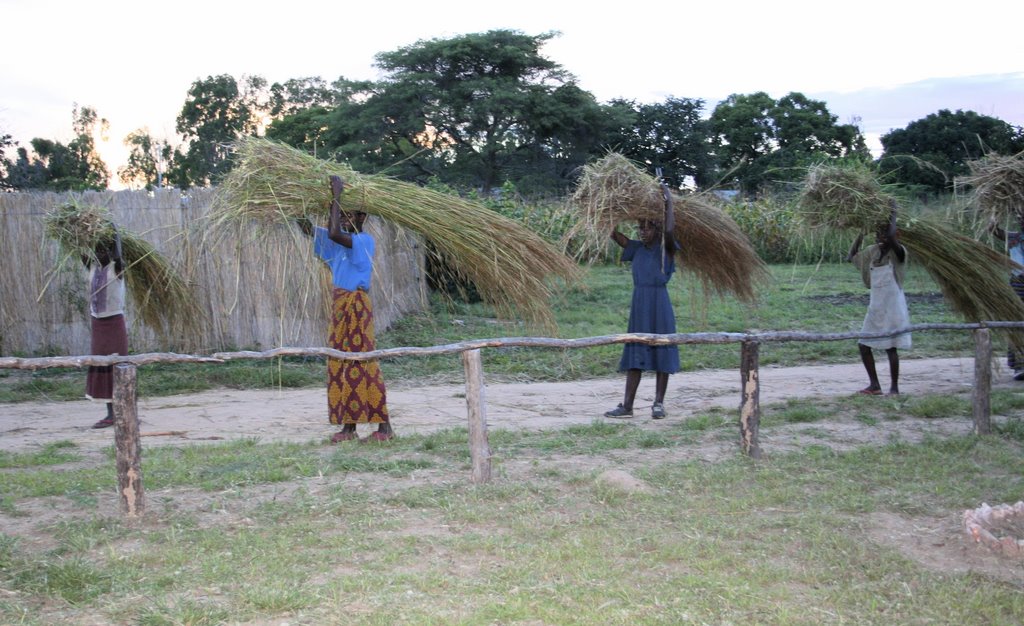
I thought of the old song title above when I saw these ladies pass in front of our house one evening. They are carrying grass that will be used for thatching roofs or building fences.
Memories of Zambia


Meg Jack is one of the Vanderbilt University doctors who stayed with us in March while doing a rotation at the Namwianga Clinic. She reflected on her experiences in a recent e-mail and agreed to let me share her thoughts on the blog. Meg writes:

Our trip was an emotional roller coaster, challenging our views of what is important in life, how we view money, our roles as physicians, and much more. I am most struck by how gracious the Zambians are and the true beauty that emanates from their faces in the midst of poverty and death. Though I will never be able to walk in their shoes and fully know how they feel, it boggles my mind that they seem much happier and content with their daily lives than many American--despite their daily struggles of facing illness, a lack of food and sanitation, and death. They don't complain, few tears are shed, and they continue to smile, put their best foot forward, and praise God for all that they have. How can that be? Maybe it is because they don't know any better, maybe it's due to the fact that they live each day to its fullest because they truly don't know if it's going to be their last, maybe it's because God knows their situation and gives them the gift of unconditional love and happiness. Whatever the reason, I will always be in awe with a permanent place in my heart for the Zambian people. I will continue to strive for that type of peace in my heart and a daily appreciation for being so incredibly fortunate.

Monday, April 10, 2006

Sandy Hill Farm


A blog entry from David this time.

Sunday afternoon I returned to the Sandy Hill Commercial Farm for a visit with the young church established only six weeks ago. With me were six young men and two young women, all students at the college or secondary. We arrived around three p.m. after slowly driving the truck through the maze of mud and thatch huts belonging to the five hundred workers and their families. We were welcomed by smiles and waves. When we arrived at the far end of the village where a clearing has been made for the church gatherings, 50 children were singing the Chitonga song "He Will Lead Us," a beautiful melody that Linda and I have come to love. No adult had arrived yet, but the children were there and waiting. They were "wearing" the crafts that Linda and her helpers had done with them on previous visits: "Jesus Loves Me" visors and fish necklaces. The children wore them proudly and it is a given that they will take care of them. It touched my heart that they were waiting for us and singing as we arrived. Jesus' command, "Let the little children come to me," pierced my heart at that moment, and I said to Him, "They're here, Lord."

A combination of village men and students led the worship. I was asked to preach and encouraged them from Paul's prayer in Ephesians 1:18-21.

The church had organized a singing group, their first one, and they wanted to sing to the Lord and the church after the service. They came to the front of the clearing and with the sun setting behind them made a joyful noise to the Lord.

Before the church dispersed for the day, it was announced that two sisters were sick and could not join us for worship. One of the leaders said, "We are going to walk to their huts and pray for them." Singing as we went, we found the women and prayed for their healing.

As the congregation escorted us back to the truck, I gazed on the many huts in this village and longed for all our friends and supporters to see what I was seeing. And then I thanked the Father above and our Savior for all those who partner with us as we minister at the "edges of the kingdom."

Friday, April 07, 2006

How Many Zambians?


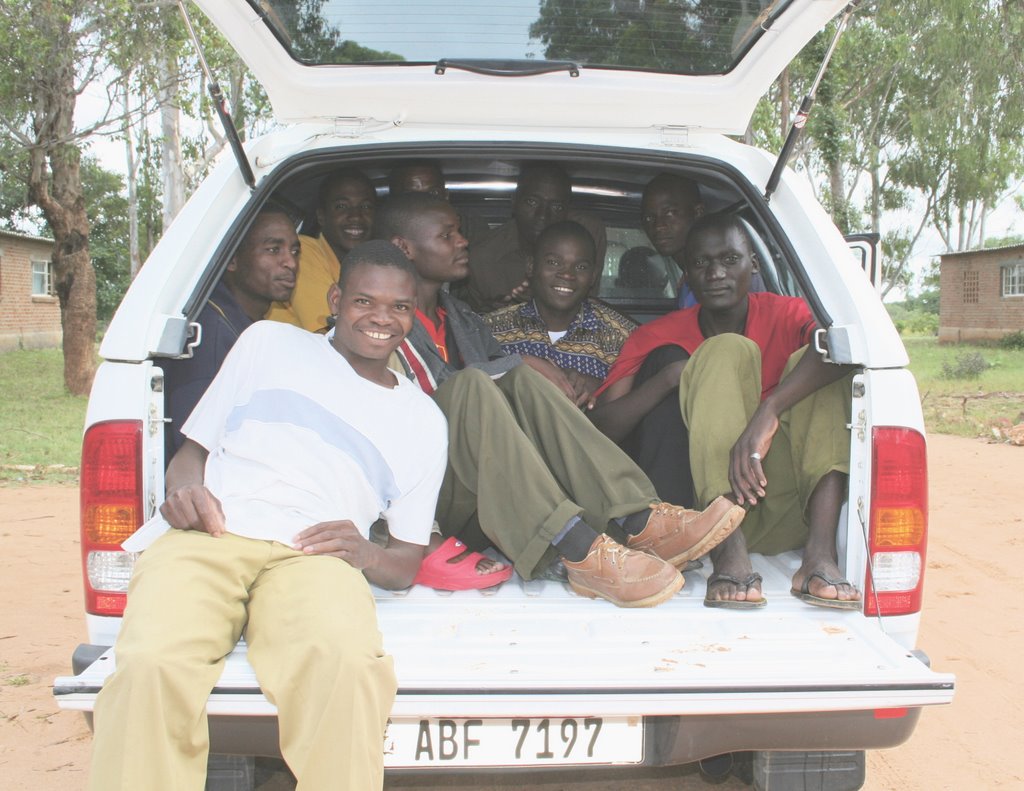
This was the group of guys who rode with me to Siabalumbi. There were four in the cab with me and these TEN in the back. I thought that we were completely full, but when we arrived back at Namwianga in the afternoon and unloaded, I found that another lady had also come along as a passenger for the return trip. This led me to do an anecdotal study to answer the burning question: How many Zambians can fit into one vehicle?


You guessed it! ONE MORE!

Siabalumbi Outreach


Last Saturday Ruhtt Mbomwae and I took this group of college guys with us to do an outreach at Siabalumbi. I've seen many beautiful places in Zambia, but none more beautiful than Siabalumbi. The school and church are set on a ridge overlooking a lush green valley that resembles a scene from a National Geographic documentary. (Even after nine months here, I still have to pinch myself sometimes to believe that I'm actually in AFRICA seeing places like this!)

The church and school building are brand new and were built with donated funds and community labor. Ruhtt is the administrator for this school as well as five other community schools in the area around Namwianga.

As usual when I go out with Ruhtt, the day was packed with activities. I did teacher training and then taught two ladies' classes back to back. The college guys taught adult and youth classes. Later in the day they organized some games and activities for the young people. After the final sermon, we trekked a mile down into the valley to the river for four baptisms. Ruhtt closed the day by distributing clothing to the community. I estimated the attendance at around 500.

Wednesday, March 29, 2006

Heavenly Echoes


Heavenly Echoes is certainly an appropriate name for the George Benson College Choir. As with the secondary choir, this one is student-led.

Secondary Choir


This is the group of eleventh and twelfth grade students from the secondary school who recorded on Saturday. They are directed by twelfth grader Prince, the young man in the middle who is not wearing a blue shirt. It is amazing to watch him in action. He does all of the arrangements of the music and directs the choir better than many professionally trained adults I have seen. The other students follow his instructions without question. As if that weren't enough, Prince has the most gorgeous voice you can imagine!

Fast Food


On Saturday our singing groups ate peanut butter and honey sandwiches served from the tailgate for lunch. We mixed orange drink in a big bucket to serve as our beverage. No one complained!

Road Trip


The big yellow bus attracts lots of attention in Zambia. David and I were following in our vehicle and enjoyed watching the reaction of people as they saw the bus. Americans were especially impressed and would wave and shout as the bus went by. This bus was shipped over from the US several years ago. It is put to good use all year round by the school and is indispensable on the medical mission.

The inside shot shows our group ready to take off on the CD adventure.

The CD Adventure

David and I often look at each other and say, “It’s another adventure!” We had plenty of opportunities for that remark this weekend as we took Namwianga singing groups to Lusaka to record CDs.

Our total entourage included three singing groups: the secondary choir composed of twenty eleventh and twelfth grade students; the Heavenly Echoes choir composed of nineteen college students and one faculty member; and the Timothy Brothers, a small group of four college students and two faculty members. The singing groups and their luggage traveled on the big yellow Namwianga Mission bus, while David and I followed in our vehicle with sleeping mats, food, water, and other supplies.

We left Namwianga on Friday at 2:00 and pulled into Lusaka just at dusk. We were met by Austin Siabeenzu, the man who coordinated most of our weekend events. Austin has many ties to Namwianga through serving on the medical mission and working with various faculty members in his role as a church leader. He is also a well-known radio personality in Lusaka where he is a cast member of a drama show.

After a quick stop for some extra diesel, Austin directed us off the main streets and we entered the huge Mutendere compound where we were to meet with the local congregation and spend the night. The streets were one-lane, unpaved, and full of huge potholes, so we had to move slowly. Vendors lined both sides, their makeshift booths lit with candles or small lanterns. Pedestrians streamed by within inches of the vehicle on both the right and left. The yellow bus drew lots of attention as people stared, pointed, and yelled. Soon some young boys decided to join our procession and walked along pounding on the truck and shouting. We navigated like this through the area for over 30 minutes before we finally reached the Mutendere building and were welcomed in the traditional Zambian way by a delegation of women singing and clapping.

Cooking fires glowed just outside the building where these same women had prepared a delicious nshima and chicken meal for us. At 9:00 the evening program began. The Mutendere group had invited the Lusaka Central congregation to join us for an evening assembly. After some spirited congregational singing and a talk by David, various singing groups presented their programs. In addition to our three choirs, the Mutendere and Lusaka congregations also had singing groups. I think the best term to describe this part of the evening might be “rocking.” I checked the rafters a few times to make sure the roof was still intact. These people love to sing and they sang with all their hearts.

Our students were exhausted after a long day, so at midnight our group was dismissed to get some sleep. The students went to a nearby school where they slept on the floor. David and I spent the night with Austin’s family. Austin dropped us off at his house and then went back to the church building. The Mutendere and Lusaka congregations stayed up ALL NIGHT LONG singing, preaching, and fellowshipping.

At 7:00 the next morning we headed for the recording studio. By daylight we could see even more of the potholes in the compound’s streets. One corner had a pothole that was over two feet deep. The bus had had a terrible time the night before at this corner, so this time the driver and Austin got out and studied the situation carefully before making the turn. The vendors on all sides of the corner had to move their wares off the street and slide their booths back to make enough room for the bus to pass. Even then the bus had to inch its way around and through the area. The entire process took over thirty nerve-wracking minutes. Since the street had only one lane, traffic was stopped from going in or out during this entire time. All of us began to have second thoughts about taking the bus back into the compound again on Saturday night.

The taping at the studio went pretty well. It was my first time to have anything to do with this type of project, so I learned a great deal, as did our students. For the most part, the groups were well rehearsed and we were able to tape one song after another. The sound engineer who worked with us was pleased and assured me that when he completed his work we would have a finished product that we could be proud of.

Since the taping went quickly and we hesitated to return to Mutendere compound because of the streets, we made the call to head back to Namwianga on Saturday rather than spend another night. We left Lusaka at 4:30 and pulled into Namwianga around 10:00 Saturday night.

David and I have taken many youth groups on trips in the US. This was a very different experience. This time we took 44 high school and college kids on a two-day outing. The students ate whatever was served them. They slept on mats on a concrete floor in a building with no electricity, no running water, and no indoor toilets. They waited for hours while other groups were taping. Number of complaints we heard: zero. Number of times we had to listen to whining: zero. Number of times any adult had to get on to any student for any reason: zero.

On Monday a group of the secondary students visited one of the administrators and asked him to convey to us their gratitude for the wonderful time they had in Lusaka. It’s no wonder we love these kids! And they can sing, too!

I’ll keep you posted on the progress of the CD. Thanks for your prayers this weekend.

Friday, March 24, 2006

It's Too Quiet!

On Wednesday we drove to Lusaka to take the visiting doctors, Meg and Christy, to the airport. They flew to South Luangua Game Park for a well-deserved rest after spending three weeks with us. Then they'll spend a couple of days in Cape Town before flying back to Vanderbilt in Nashville.

We came home to a house that seems too quiet. Meg and Christy blessed us with their visit, and we miss their laughter, their stories about their work, and our shared discussions about Zambia and its people. We hope that they will be back some day and bring others with them!

Today (Friday) we are off to Lusaka with the students who are taping a CD. I guess I should say CDs, because the project has grown. We are now planning to have one CD of the high school and college choirs and a separate one of the Timothy Brothers singing group. We will tape all day on Saturday, spend Saturday night in Lusaka, and return on Sunday afternoon. Please keep us in your prayers this weekend.

I've already begun receiving requests for copies of the CD when it comes out. What a joy it will be to share the songs of Namwianga with friends, family, and supporters in the US!

Wednesday, March 22, 2006

What a Saturday!

Outreaches come in all shapes and sizes. When Ruhtt Mbomwae plans one, you can count on something big! Ruhtt asked me to come with her last Saturday to do teacher training at Katundu where she supervises a community school. She also requested that I put together a team of sponsored students to do a children’s Bible class while I was teaching. I found four girls who were willing to go on the outreach, and we were all set.

When Ruhtt pulled up in front of our house in a 24-passenger bus, I knew there must be some even bigger plans in the works. I climbed in and joined a full crew of sponsored students from the college, most of them guys. We picked up a few more along the way and then headed up the Kabanga Road to Katundu.

We pulled off the main road and wove through the path to the village. As we broke through the last of the tall grass into the clearing around the school, we saw a huge crowd of children already gathered and waiting for us.

Ruhtt began by showing me around the school. There are currently two classroom buildings with another under construction. I asked her where the money came from to build the structures. She told me that the people in the community worked together to make the bricks and put up the walls. She got the money for the roof and doorframes by requiring each family with a child in the school to bring one chicken. She took the chickens into Kalomo and sold them to generate enough cash to finish the building project!

Ruhtt busily organized the morning’s activities. She set me up in a classroom with 10 teachers from two different community schools for a training session. She divided the huge group of children into two age groups and appointed two teaching teams. I knew she had some plans for adult Bible teaching as well, but the adults were slow in arriving. Later, when I finished my two-hour training session, I found that there were groups of 30 to 50 adults under every shade tree. Each group had a college student conducting a Bible lesson.

“Since you’re finished with teacher training, how about doing a ladies’ class next?” Ruhtt asked. Next thing I knew there were 75 ladies in front of me and I had a translator helping me teach a lesson on Jonah.

At 1:00 all the adults were gathered in one spot for a final sermon. A fiery preacher from a nearby congregation kept their attention. Several responded for baptism, so we all formed a line as we walked through the tall grass down to the river.

When we returned after the baptisms, it was after 2:00 and I was sure Ruhtt must be ready to load up and head home, so I went over to stand in the shade near the bus. Soon I noticed the crowd forming lines and saw four college guys coming off of the bus carrying huge sacks. Ruhtt finished the day with a food distribution project—each family got a plastic bag full of beans.

We finally loaded the bus and started for home. As we bumped and rattled down the road, I marveled at all Ruhtt had managed to pack into one day! I estimated that there were at least 1,000 people there, with about equal numbers of adults and children. Ruhtt made sure they were trained, taught, and fed in a single outreach effort.

Tuesday, March 21, 2006

Exciting Plans

Regular readers know how much I love the Zambian singing, especially the sounds of the choruses from the secondary school and college. For months now I have dreamed of getting a CD made of their music.

Lord willing, that dream is becoming a reality. This weekend the secondary choir, the college choir, and the Timothy Brothers singing group will travel to Lusaka to record a CD. Each group has been rehearsing nightly to prepare five to seven songs--some in English and some in Tonga--that will be included on the final product.

The schedule calls for the 48 singers to leave Namwianga in one of the big yellow buses at 1:00 on Friday afternoon to make the five hour trip. David and I will follow along in our vehicle with luggage and other supplies. On Friday evening we will be hosted by a congregation in Lusaka and will do a program of preaching and singing for them. The guys will spend the night in the church building, and the ladies will be staying in a member’s home. We have a studio reserved for Saturday for the recording. The rest of the weekend’s schedule depends on how quickly the recording goes. If we finish by early afternoon, we will head back to Namwianga. If we don’t finish in time to be home before dark, we will spend another night with the church in Lusaka and come home Sunday after church services.

Getting 50 people transported, fed, and housed has been quite a logistical challenge. As wet set out on this adventure, we ask for your prayers that we will be kept safe and that our efforts will produce a recording that will glorify God and share the message of Namwianga with many others.

Saturday, March 18, 2006

Dish Drainer


Near most huts or kitchens will be a dish drainer like the one shown. The drainer is made of poles lashed together to make a platform that provides a place for dishes to be dried and stored.

You can also notice the corn field in the background. Corn or maize is the staple of the Zambian diet, and every suitable plot of ground is utilized to grow it. Most houses have corn planted right up to the walls.

Kitchen


In the villages, cooking is done outdoors in kitchen enclosures like the one pictured. A fire is built in the center. The thatched roof keeps out the rain. Notice that grain sacks are fastened to the poles along the back and sides to provide protection from the wind.

Thursday, March 16, 2006

School Fees the Hard Way


Last Saturday was a work day for all sponsored students. The high school guys shown in the lower photo dug a hole for a pit latrine behind the guys' dorm. Mary (top) and the other sponsored college students dug dirt from the roadsides and used it to fill potholes on the road from Kalomo to Namwianga.

October Fun in March


The last two pumpkins from the harvest provided some great fun, even in the middle of March. Shown are Stacy Bruington (far left) with her children True, Lane, and Savannah. In the back with me are Christy Keyes (left) and Meg Jack, our visiting American doctors.

Saturday, March 11, 2006

Fantastic Pharmacy


Meg and Christy (see Doctors' Visit) sent out a plea to friends, family, and co-workers asking for monetary contributions to help stock the pharmacy at Namwianga. The response was immediate and generous. Dr. Sid Tate, who arrived last week from Searcy, also brought money for drugs. He took the combined funds to Lusaka on Thursday and returned with the medicines and supplies in the photo. Thousands of Zambians will benefit.

Doctors' Visit


One great blessing of our work here is the wonderful visitors who grace our lives. Dr. Christy Keyes (top photo) and Dr. Meg Jack are our latest blessings. Meg and Christy are residents in emergency medicine at Vanderbilt and are fulfilling an elective requirement by working here at the Namwianga clinic this month. They arrived last Friday, and we have been having fun ever since!

These two are up for any adventure and willing to serve any need. We wait expectantly every day for our lunch and dinner updates on their latest cases, diagnoses, and insights. It has been interesting to see Namwianga through their eyes and to compare our experiences and impressions.

Meg and Christy have quickly endeared themselves to everyone here with their cheerful attitudes and servant hearts. We hope this visit will be the first of many!

Saturday, March 04, 2006

Back in Touch

David worked and worked and worked to get our e-mail account fixed. He succeeded this morning, so we are back in touch.

Pumpkin Processing


Saturday mornings are busy times at our house, because that's when some of our students come to work for their school fees. Susan (left) and Brenda were put to work helping me get pumpkins ready to process and freeze. We had to cut the pumpkins in half, scoop out the seeds and pulp, cut the halves into smaller sections, peel off the outer rind, and cut the sections into cubes. We ended up with a huge stock pot of pumpkin pieces that I cooked, drained, mashed, and put into freezer bags.

Brenda and Susan are on my list of most-admired people. Both are orphans, and both are 22 years old. Susan had outstanding scores on her grade nine exams, but couldn't go on to high school because she had no money. She stayed at home with her grandmother for five years. Two years ago her brother provided her with funds to go back and do grades ten and eleven. Then last November her brother died. Susan came in January to ask us for help to finish grade twelve. One of the teachers at the college is an elder in the church that Susan attends, and he highly recommended her. My sister's Sunday School class had just sent some money to us to use as needed, and those funds are enabling Susan to finish high school this year.

Brenda's parents died nine years ago. An uncle cared for Brenda and her two younger siblings for a few years, but now Brenda is the head of the family and caretaker for the children. She goes to high school in the afternoons and manages to make excellent grades. I have told her that she doesn't have to come work on Saturdays if she is needed at home, but she comes anyway in appreciation for being able to continue in school.

Susan and Brenda cheerfully and willingly did their tasks this morning and sang in beautiful harmony as they worked. It is a joy to know such outstanding young ladies, and it is a privilege to help them finish their education.

Thursday, March 02, 2006

On the Line


The rainy season means that we have to do some creative drying. Yesterday the laundry was already hung outside when a thunderstorm hit. The veranda was the only dry place to finish the job.

Lost Our E-Mail

As of 10 p.m. last night our e-mail quit sending messages. We are not sure what the problem is and our efforts to contact the provider have been fruitless so far. The really sad part is that I had worked all evening to get our newsletter ready to go out--and then we couldn't send it! We're not sure how long we will be out of touch. We can still receive messages, but don't expect a quick reply.